
This is another rare post without charts from me, but I want to write some important posts about the prospects for US equities and oil prices over the summer and need to write a post first about the Iran peace process to refer back to as I write those.
Just to be clear, I am not talking in the title about the bumpy road behind us in the road to peace with Iran, I am talking about the bumpy road ahead as the peace process hopefully evolves from the Memorandum of Understanding (MOU) signed yesterday to a more permanent peace.
12th March - It Takes Two To Tango
24th March - There Is No ‘I’ in TACO
31st March - Trump’s Tar Baby
8th April - Apocalypse Postponed
In my post on 8th April I listed Iran’s ten point proposal for ending the war as follows. This was in essence the same plan they presented a few days into the war as a precondition for talks:
A guarantee that Iran will not be attacked again.
A permanent end to the war, not just a ceasefire.
An end to Israeli strikes in Lebanon and against Iranian allies.
Lifting of all US sanctions in Iran.
Reopening of the Strait of Hormuz with a transit fee of $2 million per ship.
Continuation of Iran’s control over the Strait of Hormuz.
Acceptance of Iran’s right to enrich uranium for its nuclear program.
Compensation for war damages to Iran.
Withdrawal of US combat forces from the region.
End to all UN and IAEA resolutions targeting Iran.
This was the agreement signed yesterday which, with minor tweaks was in essence that same initial proposal from Iran, fleshed out in more detail:
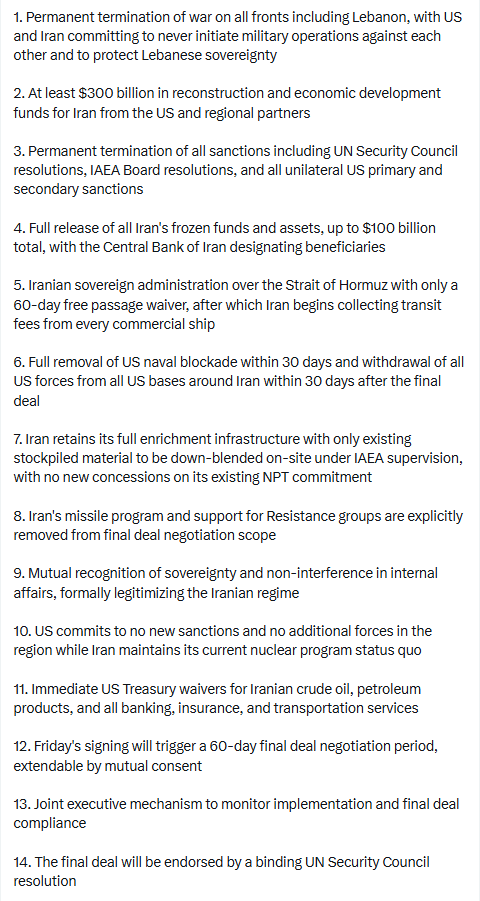
In essence therefore the US has ultimately accepted all Iran’s demands to end this war after a long period of trying to sweeten this bitter pill with negotiation and threats.
In terms of the war the US showed up with aircraft carriers and fighter jets to a war fought with cheap drones and supply chains. Iran blocked the Strait of Hormuz and were prepared to do whatever it took to hold it until the shortage of oil inflicted major damage on the world economy. The US has the most impressive military and naval forces on the planet but the only way to open the Strait by force would have involved a ground invasion that would likely have resulted in large numbers of US casualties. That wasn’t a realistic option & so there was no viable way forward for the US in this war.
Trump has returned from Versailles to a firestorm of disapproval from Republican lawmakers, but I think Trump took the least bad option here to avoid a far worse outcome. That can’t have been easy but the key was what he said at Versailles yesterday which was that the deal needed to be done to avoid a potential economic meltdown from a shortage of available oil. In my view he was right, and to make this agreement took courage. I am surprised that he did this now but I had clearly underestimated him.
Starting this train wreck of a war was the mistake made here, and there was no way to undo that mistake. Trump was very poorly advised before this war started, mainly by Netanyahu and Hegseth, and Netanyahu has now likely lost much of his influence with Trump as a result. I suspect that both Netanyahu and Hegseth may be exploring alternative employment opportunities in the easily foreseeable future. JD Vance appears to have been a lonely voice in the Administration opposing the war before it started, but it appears he may be the scapegoat for making this agreement regardless.
So what now?
Now this MOU has some serious obstacles to negotiate on the path to a more permanent peace and, as I mentioned, getting past those obstacles may be a bumpy ride.
The first big obstacle is the US Congress, and the Iran Nuclear Agreement Review Act of 2015. Now it might be argued that this law only applied to Obama’s JCPOA, which the US withdrew from in 2016, but if it still applies, and I am reading that it does still apply, then Congress will need to review any agreement for up 30 or 60 days before deciding whether any sanctions on Iran can be removed.
Judging by the furore among legislators since the MOU text was agreed, that congressional approval might be hard to secure.
Regardless of whether this law applies it is hard to see how a more permanent agreement can be made without congressional approval.
The second big obstacle is Israel which has made no secret that it is unhappy with this agreement and has also made clear that it will not be withdrawing from Lebanon. It has been violating the ceasefire that explicitly includes both Israel and Lebanon, even though the MOU was only signed last night. Without Israel behaving, Iran has been very clear that it will consider any agreement void, and will re-impose the blockade on the Strait of Hormuz:
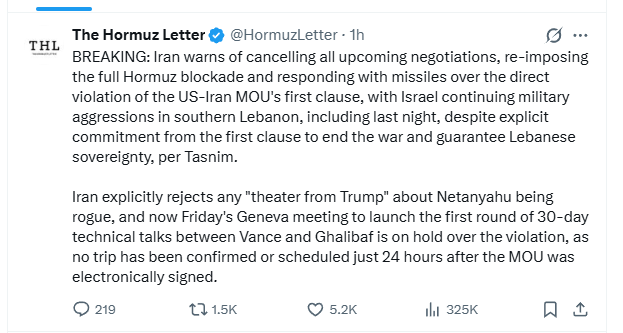
Are the Iranians prepared to exclude Israel from the peace deal? Likely not as with good reason they view Israel as heavily dependent on the US and therefore within their control. Does the US possess either the ability or the will to force Israel to comply with the peace process? Maybe, we’ll see.
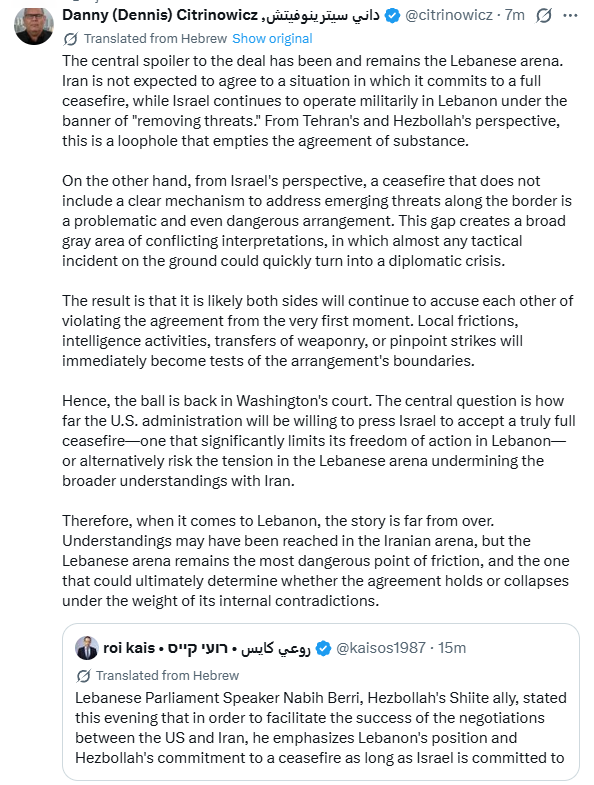
There are numerous other smaller but significant issues which include:
There is a backlash among US legislators who seem to have picked up the impression from somewhere that the US had won this war, and are outraged about a peace deal that leaves the US in a demonstrably much weaker position in the Middle East than it was in before the war started.
The US seems to have agreed to the Iranian demand that it withdraw from all US bases in the Persian Gulf states, which reduces US influence in the region and leaves Israel looking increasingly isolated. If the US becomes just another big power in the Middle East that potentially threatens longer term the dominance of the US Dollar as the world’s reserve currency, and potentially also the continued existence of Israel unless Israel is prepared to make peace with their neighbours.
There is also the fact that world oil stocks are low after several months of the Strait of Hormuz being closed, and that even with the Strait reopened it will take up to ten weeks for those tankers passing through the Strait to reach their destinations. Even if the Strait stays open there may be a serious shortage of oil across the world in coming weeks, and I’ve seen estimates that it may take a year or two for the oil supply & demand equilibrium to be re-established and settle down again.
Overall the road to a more permanent agreement will be bumpy, may take several months to agree, and may face very serious opposition from US legislators and Israel.
In terms of oil supplies the Strait of Hormuz may be closed again at various points during the negotiations and, even if that doesn’t happen, low oil stocks in the world may still deliver some wild price spikes on oil before oil supply and demand reach a new equilibrium.
If you like my analysis and would like to see more, please take a free subscription at my thebiggerpicture substack, where I publish these posts first and for members also bi-weekly videos looking at equity indices, bonds, currencies and commodities. Those videos are posted on my Youtube channel after a seven day delay. Links to all my posts from my charting substacks are also always posted on my twitter.
No comments:
Post a Comment