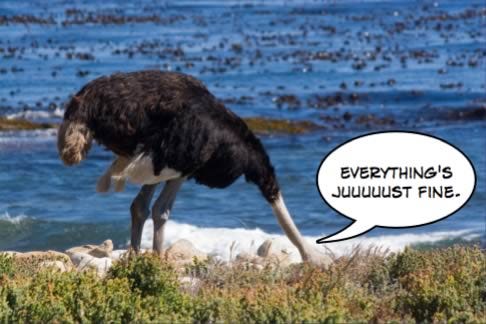
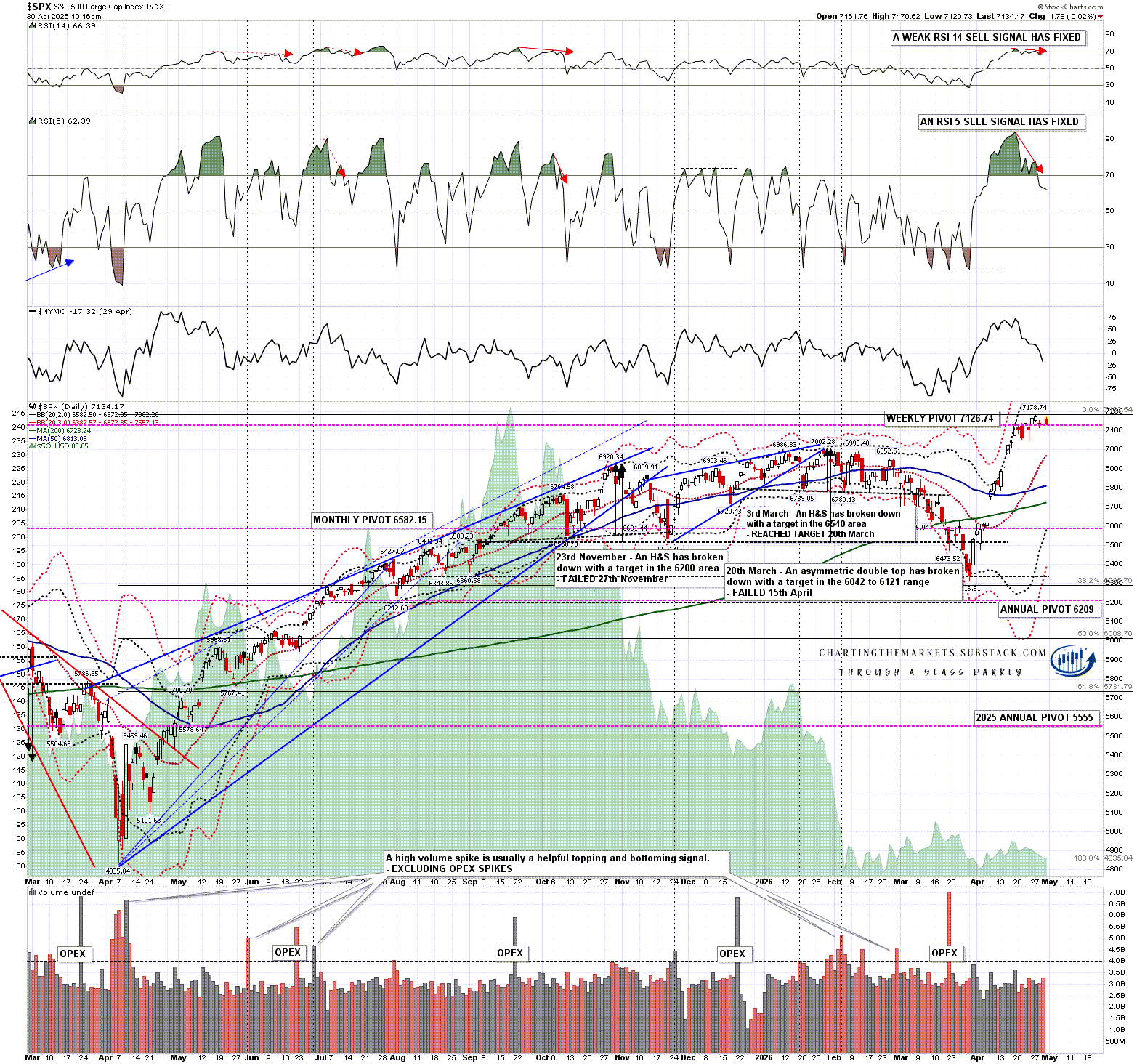
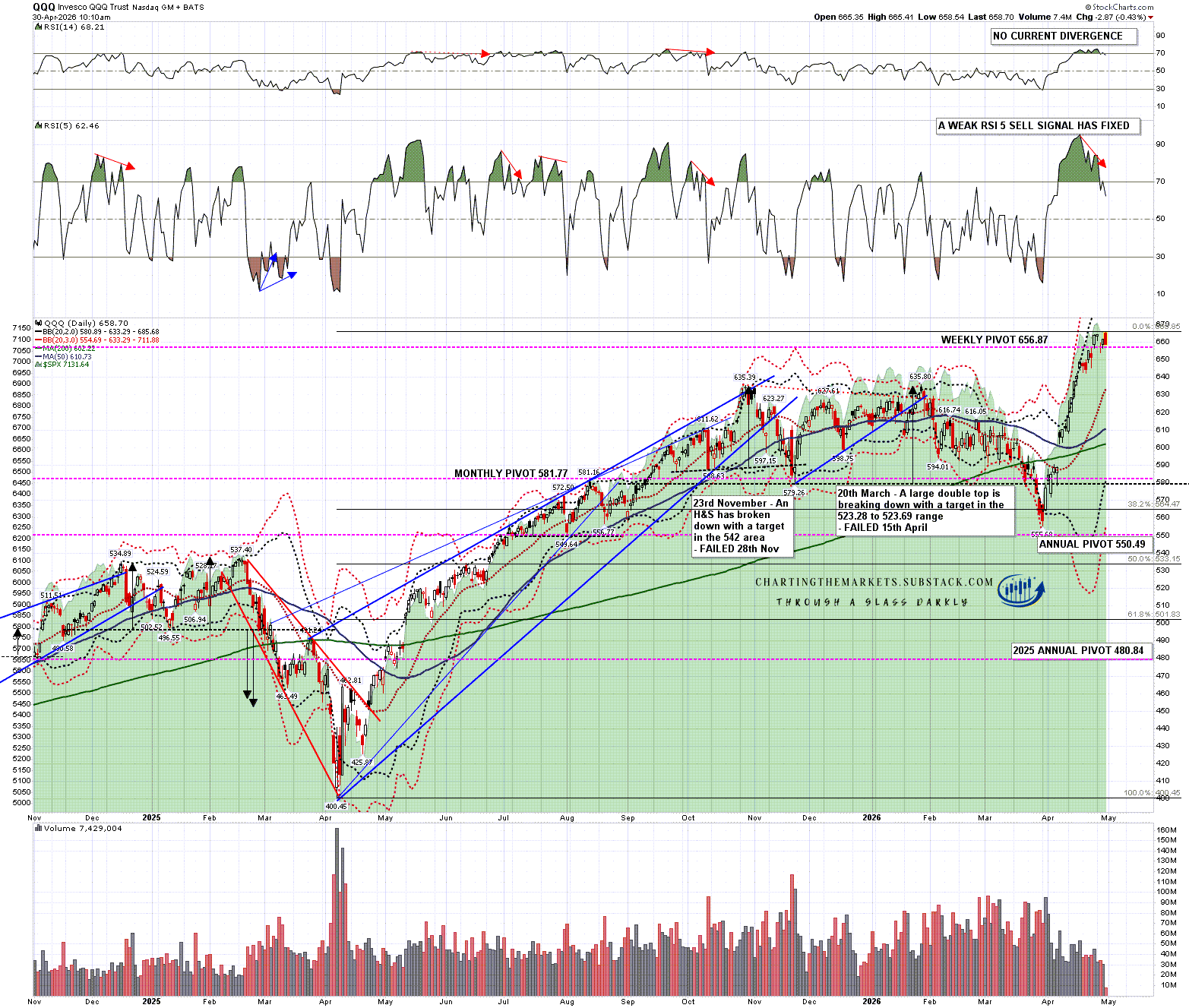
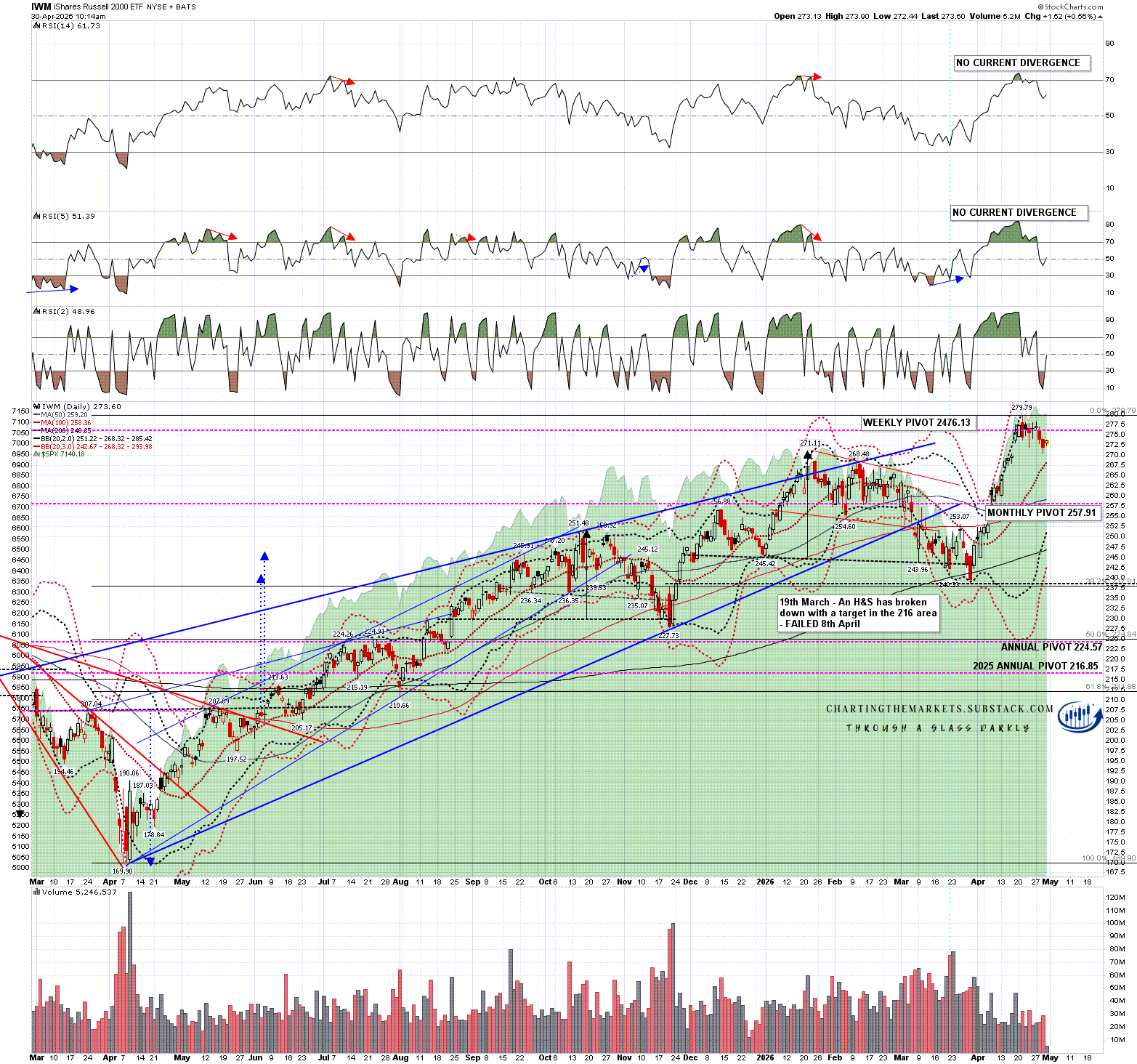
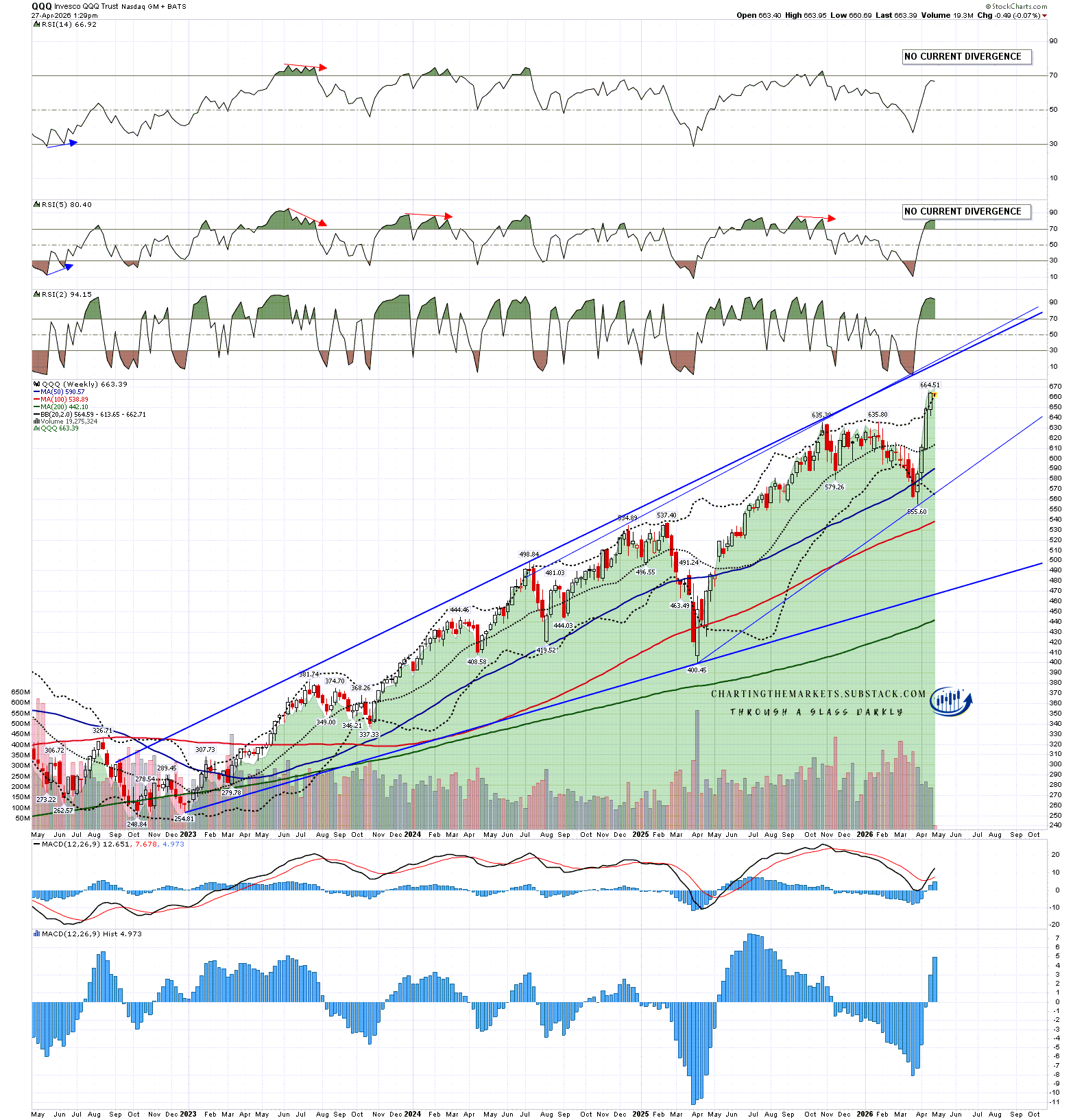
- WE'RE JUST RANDOM SPECKS OF DUST IN A TORNADO TO THE MARKETS .......
- CHARTISTS MUST PUT ALL BIAS ASIDE AND LET THE CHARTS DO THE TALKING OR WE'LL SEE ONLY WHAT WE WANT TO SEE
- This blog has a copy of all header posts that I publish anywhere, so that those interested in seeing what my thoughts are on the markets can find them easily.
- I will be answering questions and responding to comments, so feel free to respond to any posts and I will see your comment even if it is not on the most recent post.
- If you're interested in seeing any intraday charts I post, I do that on twitter, and my twitter handle is @shjackcharts.
- The charts in the posts are as large as I can practically make them. if you would like to look at one more closely, click on it, and the link will take you to a larger version at screencast. If you click on that again, you will get a full page version, and can use the resizing function on your browser to enlarge parts of interest further.

Thursday, 23 April 2026

So Far, So Good in The Strait of Hormuz

I’ve written well over two thousand posts over the last sixteen years, and this will be the first that doesn’t include any charts that I drew myself. That feels a bit strange but I’m writing this post to draw everyone’s attention to what is really important about this Iran War.

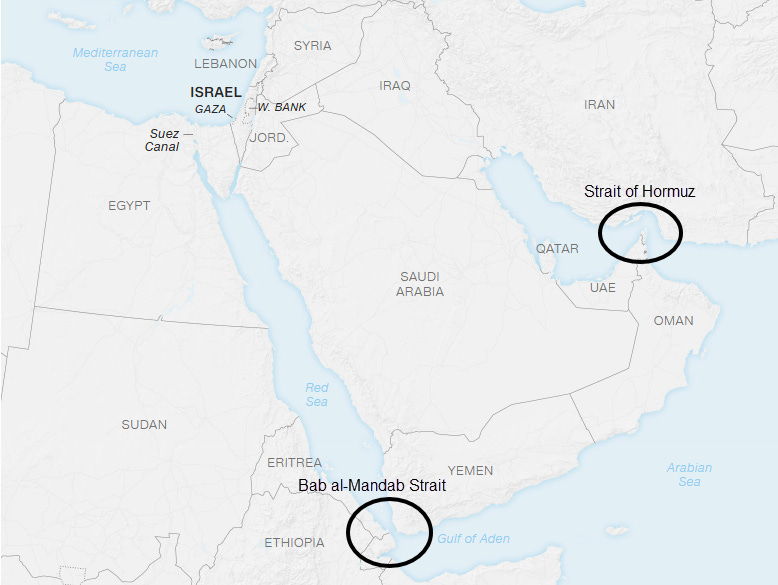
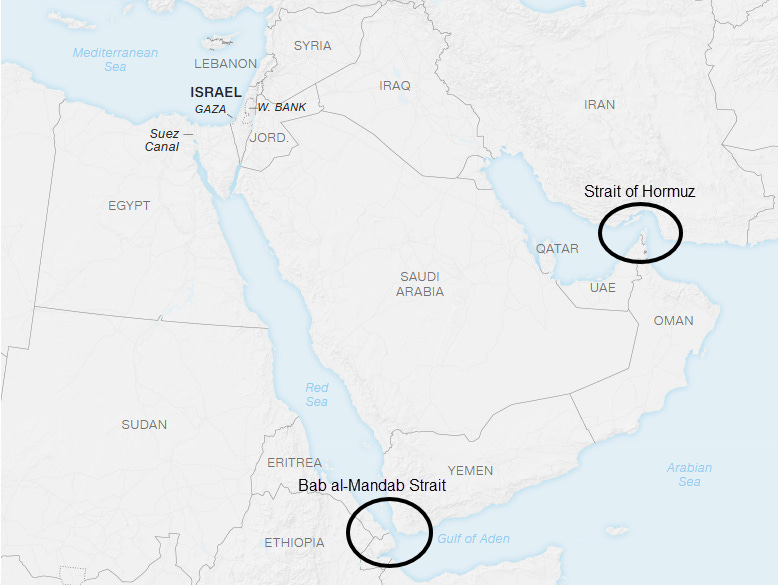
The war itself is largely irrelevant. Whether the US, Israel or Iran are bombing, or blockading, or blustering doesn’t really matter. All that is really important on the bigger picture are the Strait of Hormuz and, to a slightly lesser extent, the Bab al-Mandab Strait, the two key chokepoints for world trade routes in the Middle East:

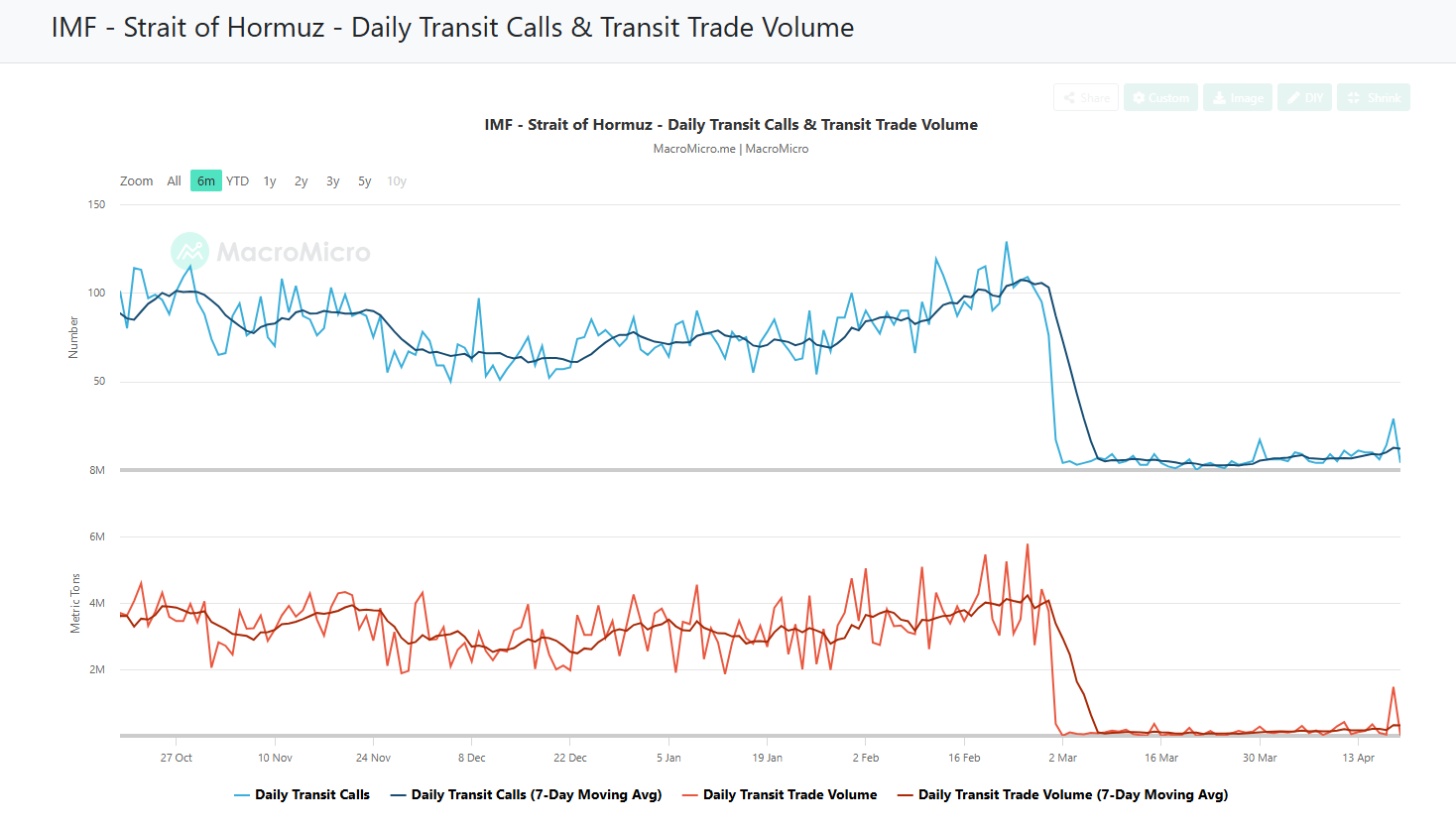
What is important here is that the amount of tankers and trade volume through these Straits, and that traffic through the Strait of Hormuz dropped over 90% at the start of this war and has on average remained at or below that level since then.

To put that in perspective the last oil tanker that passed through the Strait of Hormuz before this war started delivered that cargo on Monday 20th April. After the war started there was a grace period while the tankers still on the sea delivered their cargoes. That grace period has now ended and the Strait is still closed.

There are still oil reserves that have been released to work through, but once they are used up this supply shock will be fully on, and prices will rise to destroy demand until supply and demand for oil balance again. That is what an oil shock is really about.

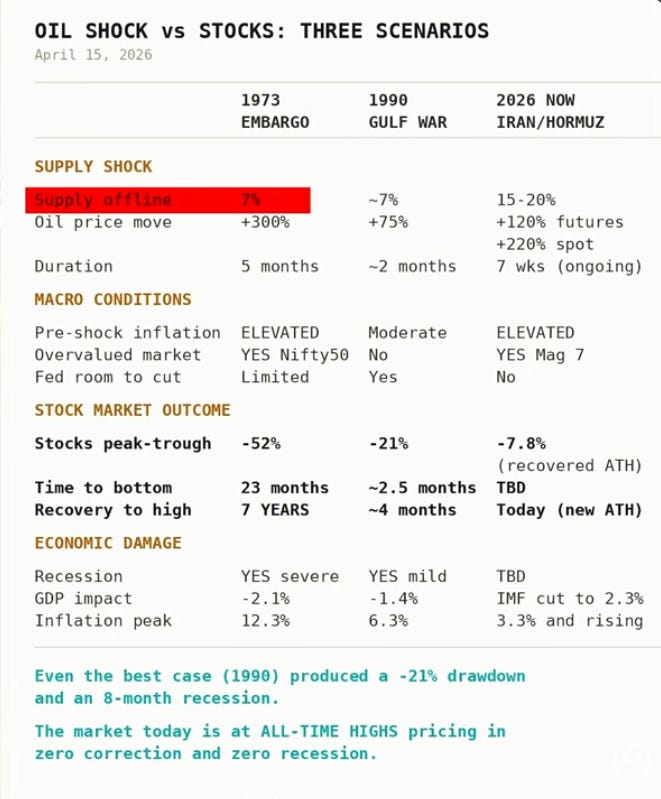
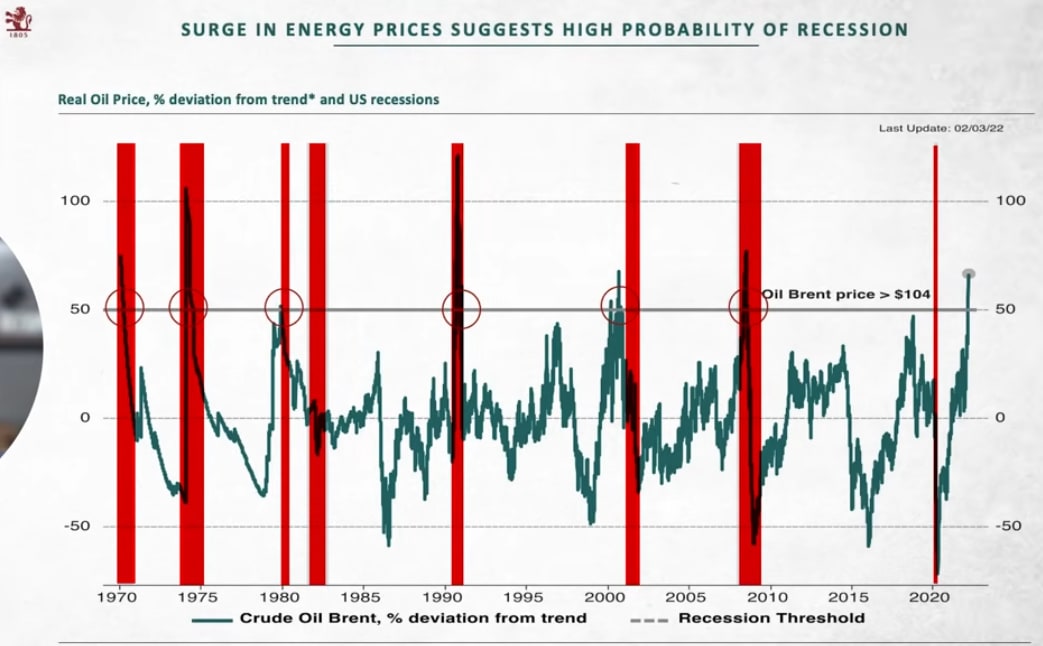
There are two previous oil supply shocks historically to compare this crisis with, the first in the 1970s and the second when Iraq invaded Kuwait in 1990. In terms of the percentage of world oil supply disrupted both were smaller, and this disruption is already close to lasting longer than in 1990 and may yet last longer than the five months in 1973.

The summary below looks at what happened in these two previous supply shocks to oil prices, equity valuations, GDP and inflation and it is grim reading:

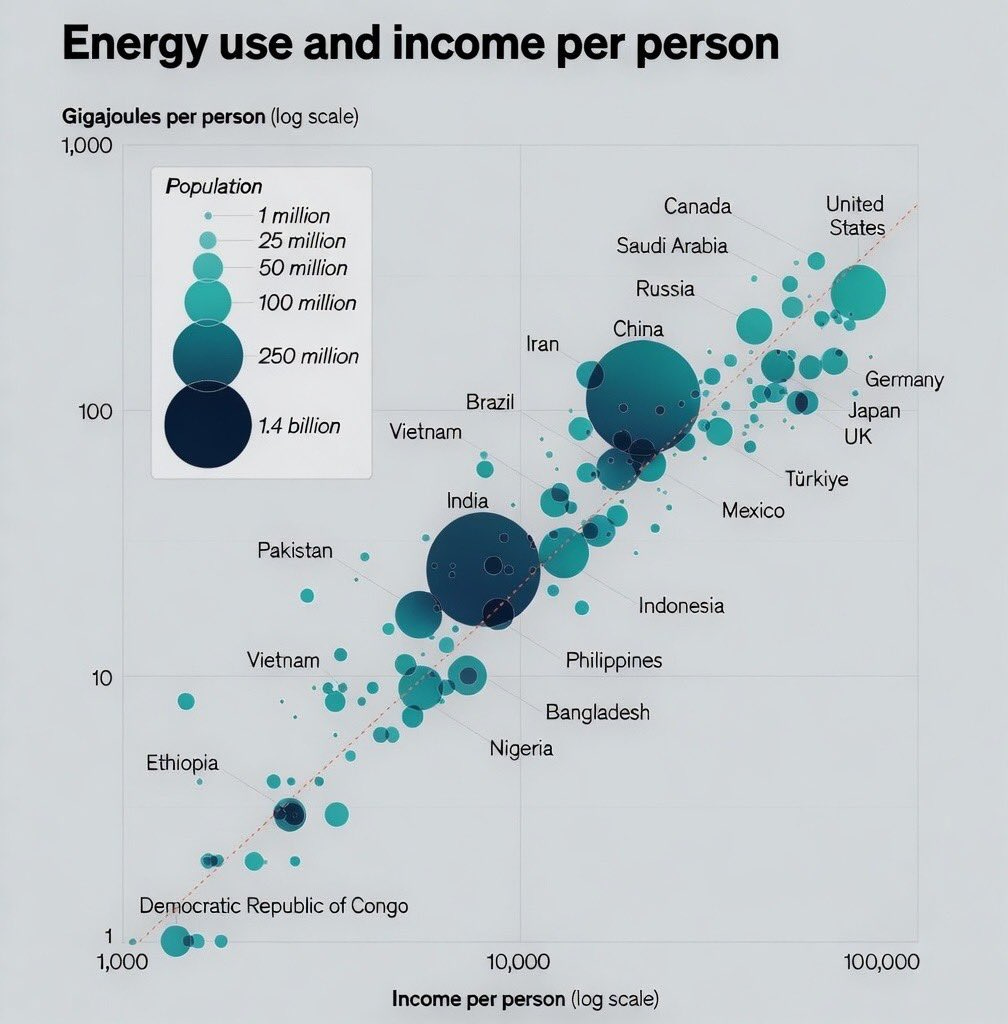
It isn’t just about oil of course, 30% of helium worldwide comes from Qatar and and much of that capacity has been damaged in this war and will be offline for years. That capacity is not obviously even possible to replace, as it is produced as a byproduct of Natural Gas, and prices have already risen over 50% in the demand destruction cycle to balance supply and demand. Helium is vital to semiconductor manufacturing among other uses.

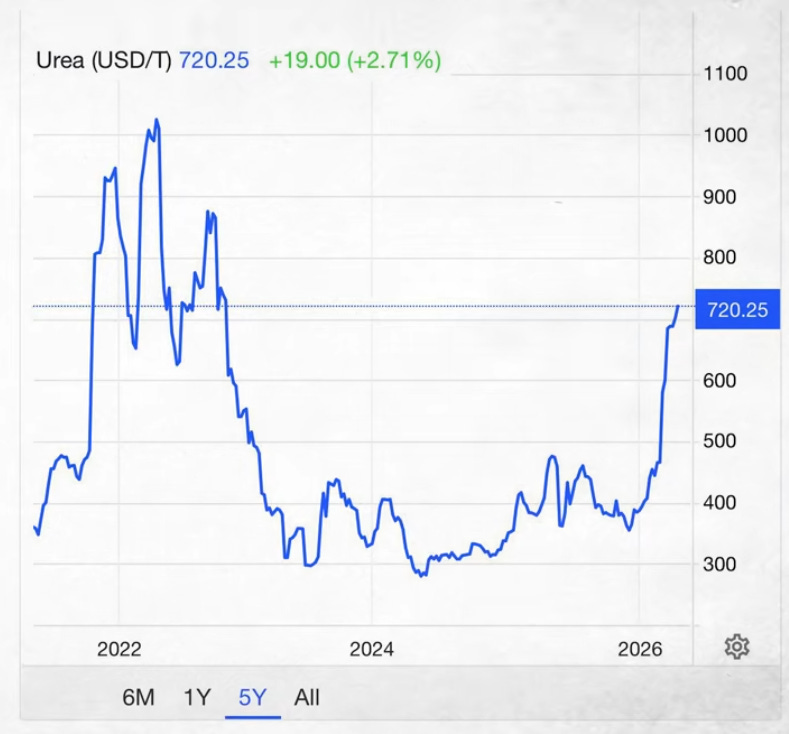
Other major disruptions include aluminium and urea, which is very important for fertilisers. The chart below is Urea prices from the start of 2022, rising rapidly back towards the 2022 highs. This will restrict world food production and deliver higher food prices that will feed though (no pun intended) over the next few months:

In terms of the impact on equity prices, the milder outcome was in 1990 when stocks were slightly overvalued and stocks dropped 21% peak to trough. In 1973 stocks were somewhat more overvalued and markets dropped 52% peak to trough over the next two years, only recovering to the previous highs after seven years.

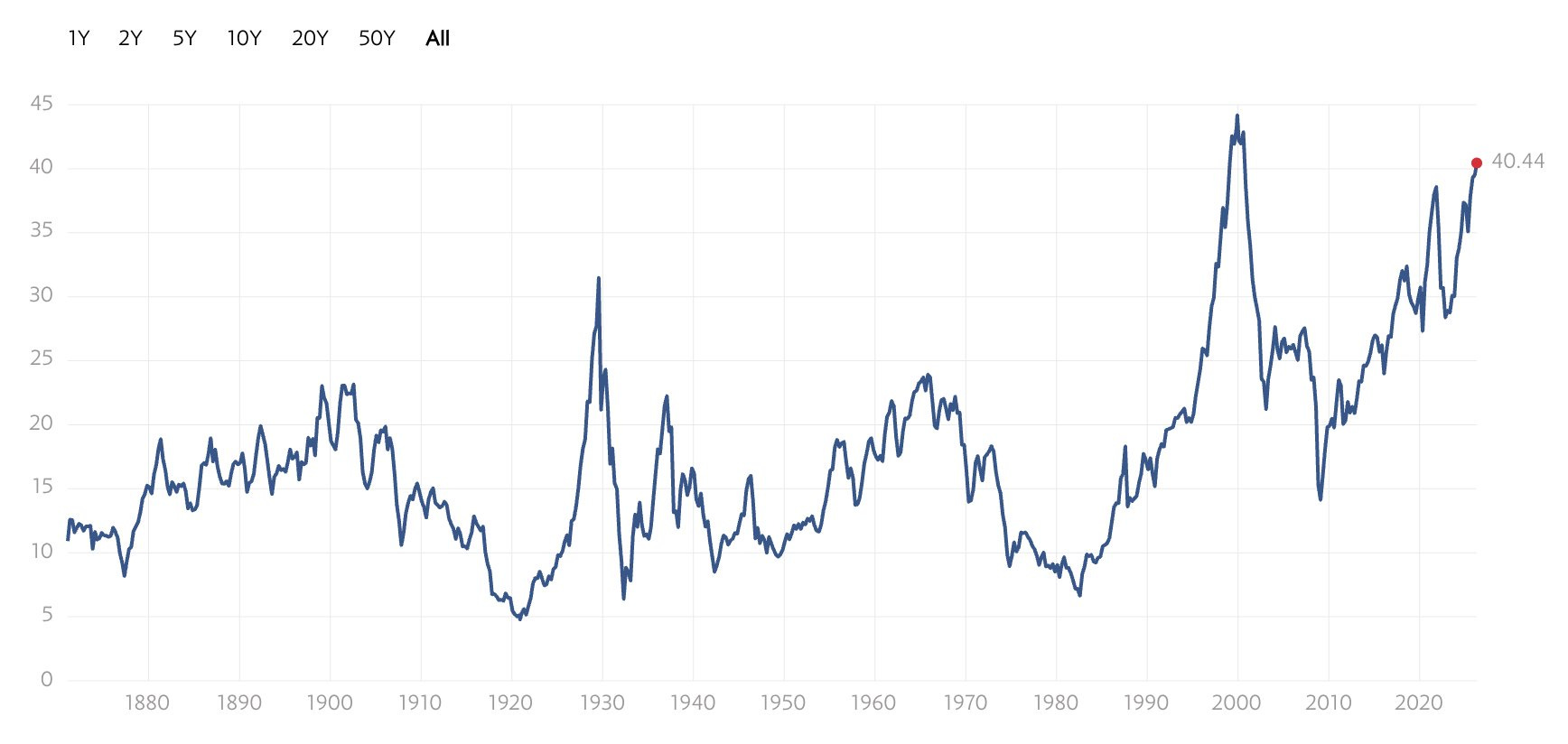
So are stocks overvalued now? Well the chart below is the Schiller P/E ratio since 1870. The current level is 20% higher than the high in 1929, and about 10% lower than the all time high in 2000. For comparison the Schiller P/E ratio was at about 18 in 1973, and 17 in 1990 against a historical mean (before 1990) in the 14% to 15% area. It is currently over 40. There is a strong argument that stocks are extremely overvalued here.

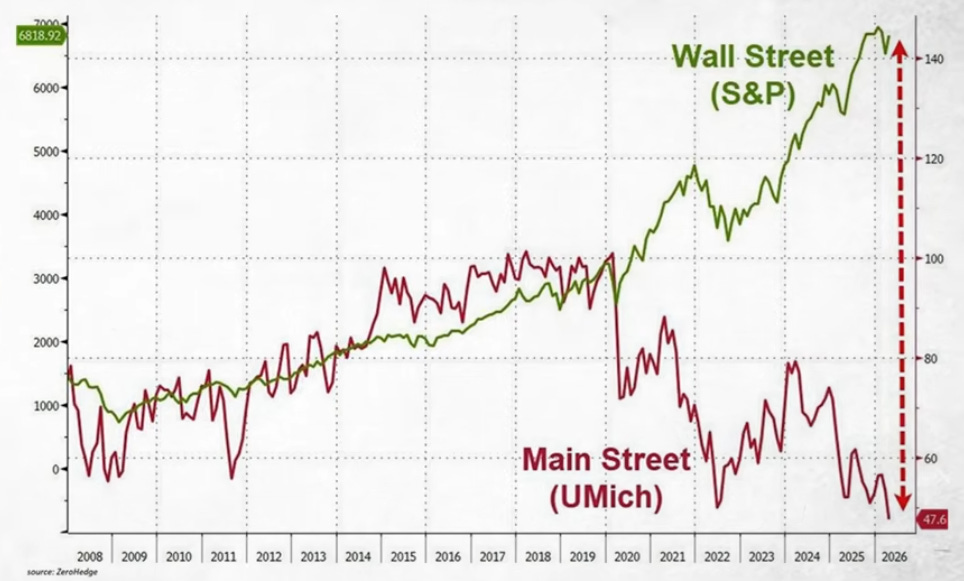
How fragile is the market? Are market expectations diverging from the real economy? The chart below is a look at the S&P and Consumer Sentiment since the start of 2007. It is a thought-provoking chart:

The bottom line here is that all that really matters here is the supply shock to the world from this war in the Middle East. Nothing else is of global importance. Until commerce is flowing freely through these Straits, whether or not Iran is charging a toll, the world is exposed to a severe economic shock , stagnation and inflation. The US is a large oil exporter and is more insulated from this crisis than many, but is a long long long way from immune.

Once this supply shock ends we can see how bad this shock is likely to be as the effects feed through over the next few months and years. So far the speed of international trade has insulated the world from this supply shock but that won’t be the case going forward.

We have yet to see the real effects of this Iran War, and it is important to remember that the news about the war that we see every day is mostly just noise, of no real importance on the bigger picture here.

Overall this situation reminds me of a joke my father used to tell. A man jumps off the top of the Empire State Building and halfway down the building is heard to say ‘so far, so good’. It isn’t the fall that kills you, it’s the landing. That is the thing to focus on.

If you like my analysis and would like to see more, please take a free subscription at my thebiggerpicture substack, where I publish these posts first and for members (from next week) also bi-weekly videos looking at equity indices, bonds, currencies and commodities. Those videos are posted on my Youtube channel after a seven day delay. Links to all my posts from my charting substacks are also always posted on my twitter.

Tuesday, 21 April 2026

The Four Horsemen - Cotton, Wheat, Corn and Soybeans

There were four big setups, each covering multiple tickers, that I was looking in my bi-weekly The Bigger Picture webinars last year and at the start of this year that looked very strong, but I was struggling to come up with any decent fundamental reasons why they might play out.

That changed when the US attacked Iran on 28th February, and since then I have been looking at these four big setups as follows:

War - I looked at the oil setups in my posts on 3rd and 13th March. Those setups have made the first targets but haven’t yet made the extension targets at retests of the 2022 highs on $BRENT, $WTIC and $GASO.

Pestilence - In my last The Four Horsemen post on Friday 27th March I was looking at the US Dollar, and that hasn’t changed much since as we are currently waiting to see if attempts to end the Iran War might be successful.

Famine - Today I am looking at the third series of setups, on $COTTON, $WHEAT, $CORN, and $SOYB.

Death - This will be the next and last in this series looking at bonds, and will give a preview of what might happen if the current US experiment in ever rising deficits and debt ends really really badly.

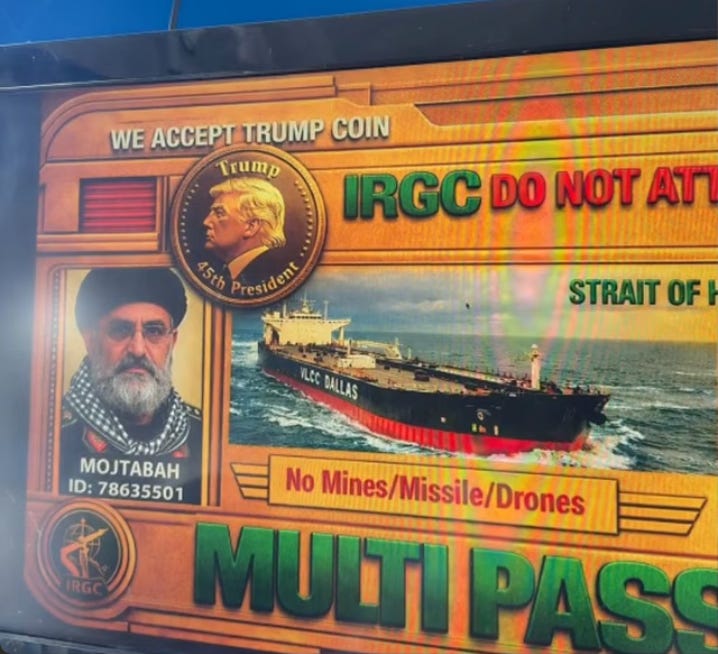
In term of the current ceasefire and the Strait of Hormuz almost everything about the ceasefire is obscured by a fog of confusion, but what does seem clear is that the Strait of Hormuz remains under Iranian control, that when it is open at all they are charging a stiff toll on all vessels passing through the Strait, and are insisting on payment in either Yuan or Cryptocurrency. In case you were wondering, they are welcoming payment in Trump Coins:

The main focus on the trade disruptions from the Iran War has been on oil, but there are other important goods which have been severely disrupted including Liquefied Natural Gas (LNG), Helium (vital for semiconductor manufacturing), and fertiliser, as the Persian Gulf is a very large source of Urea. It is the fertiliser disruption that concerns us today.

That disruption has been serious, prices are well up and there are serious shortages and price spikes that have already had a serious impact on the Spring planting season for both Wheat and Corn. Enough disruption may already have been caused to deliver the squeeze in supply that I am looking at in the charts below, and all four of the crops I am looking at below use a lot of these disrupted fertilisers.

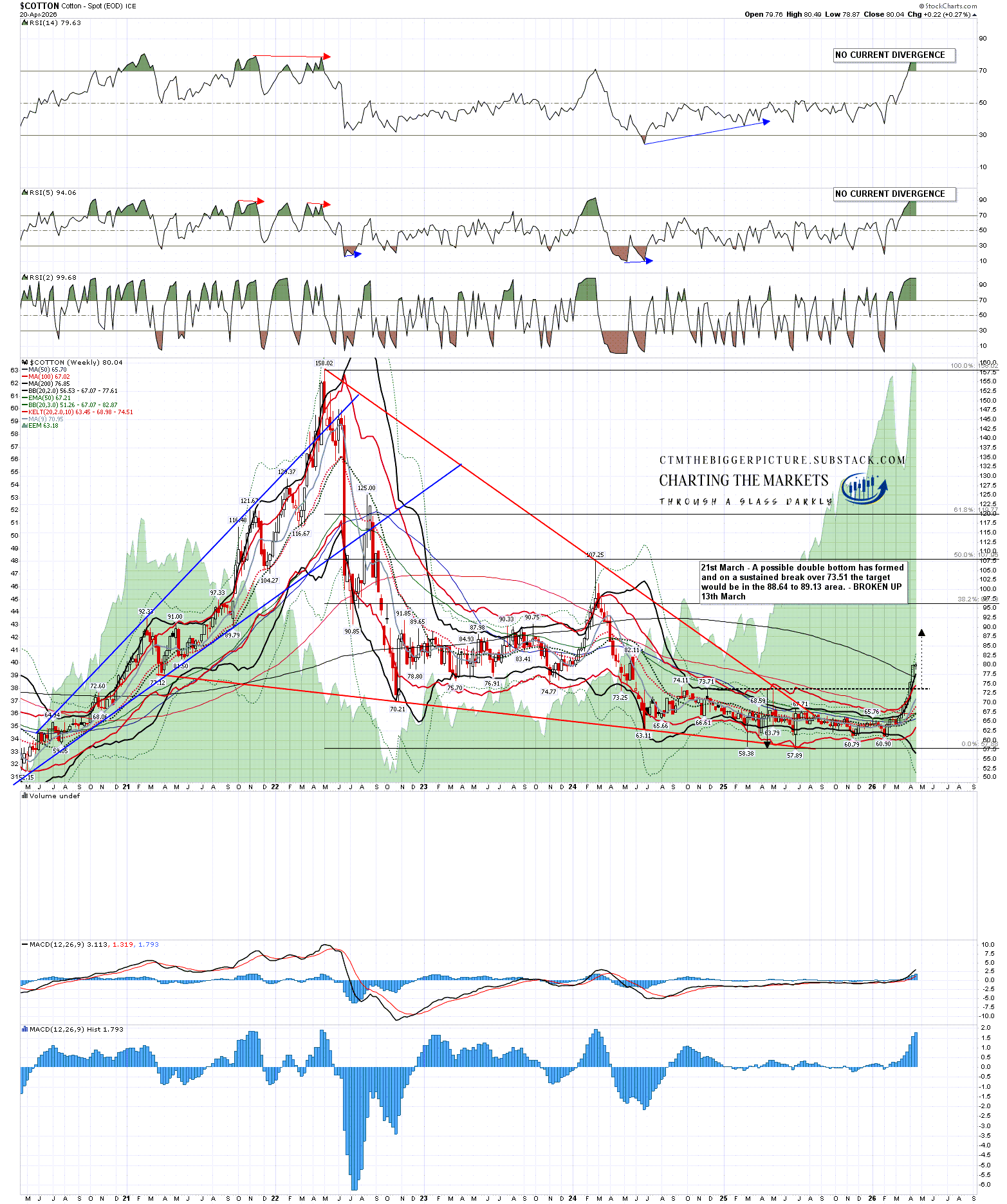
The first on the list is Cotton, which broke up on 13th March from a double bottom looking for a target in the 88.64 to 89.13 range. This is a big move but looking at Cotton from the high in 2022 after the invasion of Ukraine this is still less than a 38.2% retracement of the falling wedge from that high into the lows made last year. This could potentially further deliver a move higher into a retest of the 2022 high, in which case I’d be watching the possible IHS neckline or asymmetric double bottom resistance at 107.25, close to the 50% retracement of that rising wedge.

COTTON weekly chart:

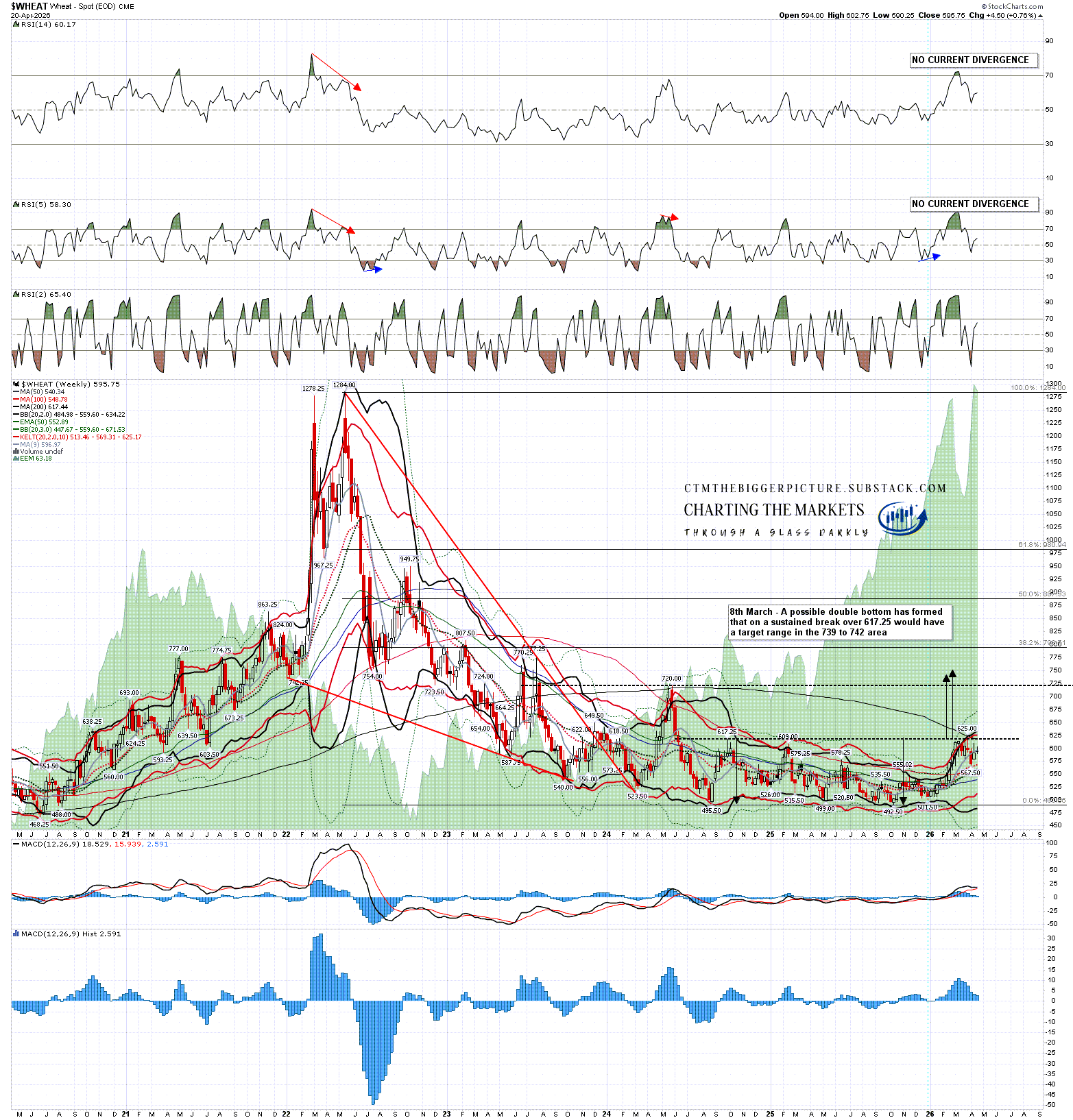
The second on the list is Wheat, which broke up very slightly from a double bottom looking for a target in the 739 to 742 range. This is a big move but looking at Wheat from the high in 2022 after the invasion of Ukraine this is still less than a 38.2% retracement of the falling wedge from that high into the lows made in 2024 and 2025. This could potentially further deliver a move even high, in which case I’d be watching the possible IHS neckline or asymmetric double bottom resistance at 720. There’s nothing here currently to suggest a move that might exceed at 61.8% retracement of that rising wedge.

WHEAT weekly chart:

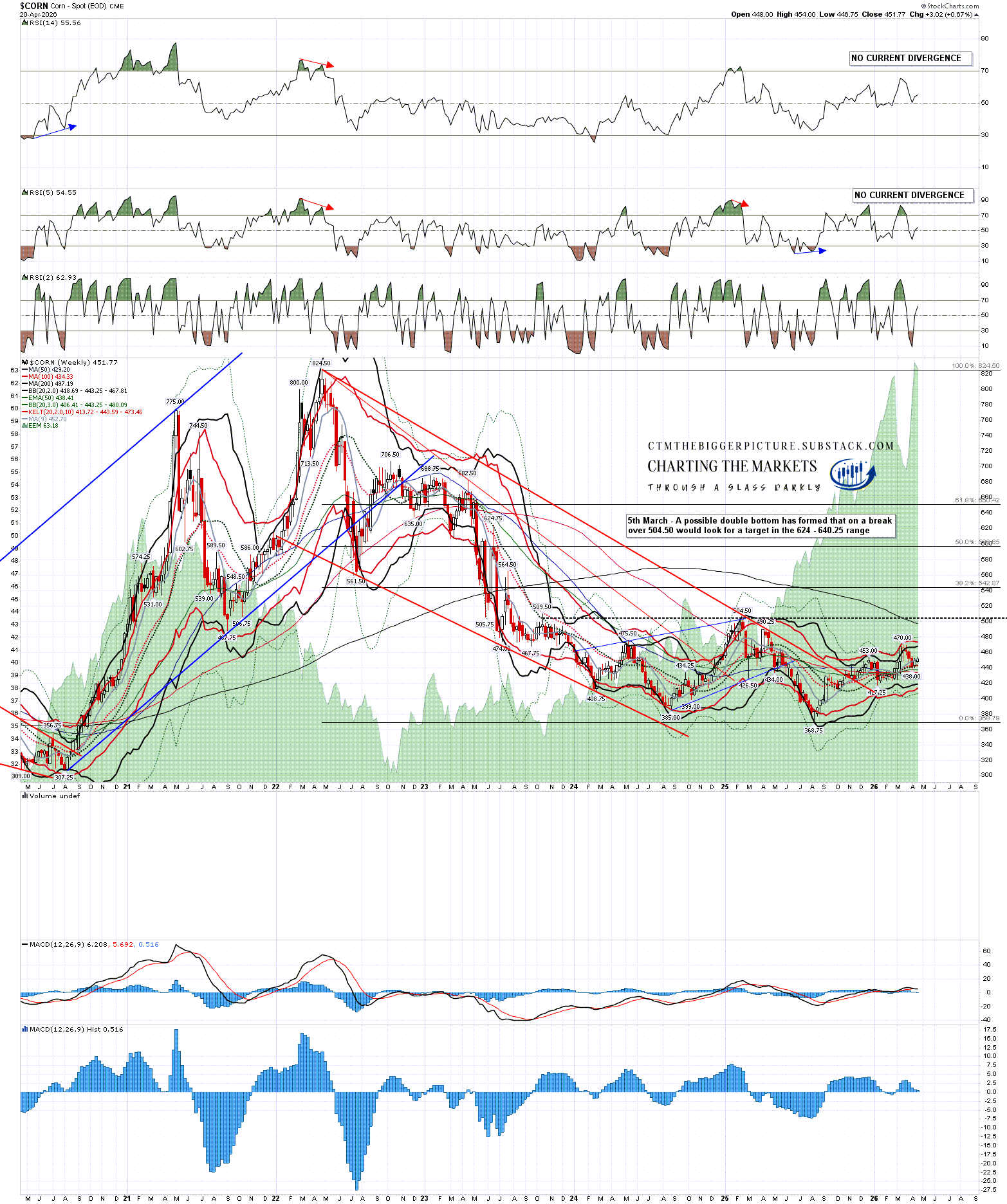
The third on the list is Corn, where a double bottom setup has formed that on a sustained break over 504.50 would look for a target in the 624 to 640.25 range. This would be just under a 61.8% retracement of the falling wedge from the 2022 high to the lows in 2024 and 2025. There’s no obvious path higher at the moment unless a right shoulder forms near the possible IHS neckline in the 564.50 area.

CORN weekly chart:

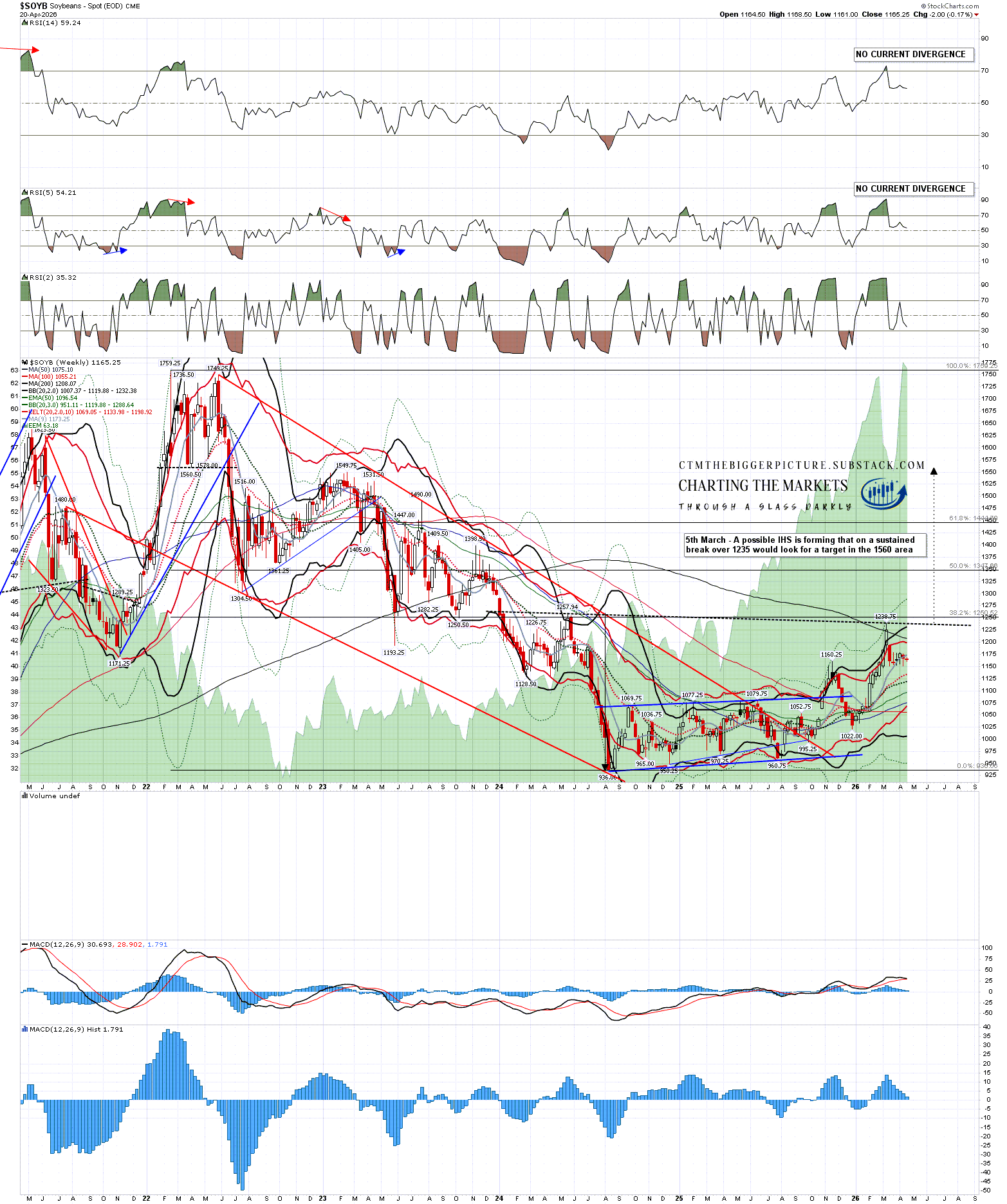
Soybeans are the only one of these crops that had not formed a double bottom by the start of this year. I had been expecting one as a clear bear flag channel was forming for over a year from the low in 2024. That bear flag broke up though, came close to a retest of the possible IHS neckline at 1257.94, and has since been pulling back in what may well be an IHS right shoulder. A sustained break over 1235 would look for a target in the 1560 area, close to a 76.4% retracement of the falling wedge from the 2022 high into the low in 2024. There is no obvious path higher from there.

SOYB weekly chart:

To a large extent these setups are just routine retracements of their big moves down from the major highs made in 2022, and they are very possibly not dependent on a further escalation of the Iran War. These moves may already be baked in from the disruption of the last few weeks affecting the crops to be harvested over the next few months.

I’m planning a post over the next few days looking at possible options trades to take advantage of these moves.

The next post in this series will be looking at the bullish setups on bond yields. These are by far the scariest looking setups here and I’m aiming to get that out by the end of April.

If you like my analysis and would like to see more, please take a free subscription at my thebiggerpicture substack, where I publish these posts first and for members (from next week) also bi-weekly videos looking at equity indices, bonds, currencies and commodities. Those videos are posted on my Youtube channel after a seven day delay. Links to all my posts from my charting substacks are also always posted on my twitter.

Monday, 20 April 2026

Schrodinger's Strait

In my post on Tuesday 31st March I was saying that the likely best thing that could happen in the Iran War was that the US declares victory and that the war has ended regardless of any input from Iran. This would avoid further escalation and the major economic shock to the world economy that would likely result from longer term disruption to the Strait of Hormuz and likely also the Bab El-Mandeb Strait.

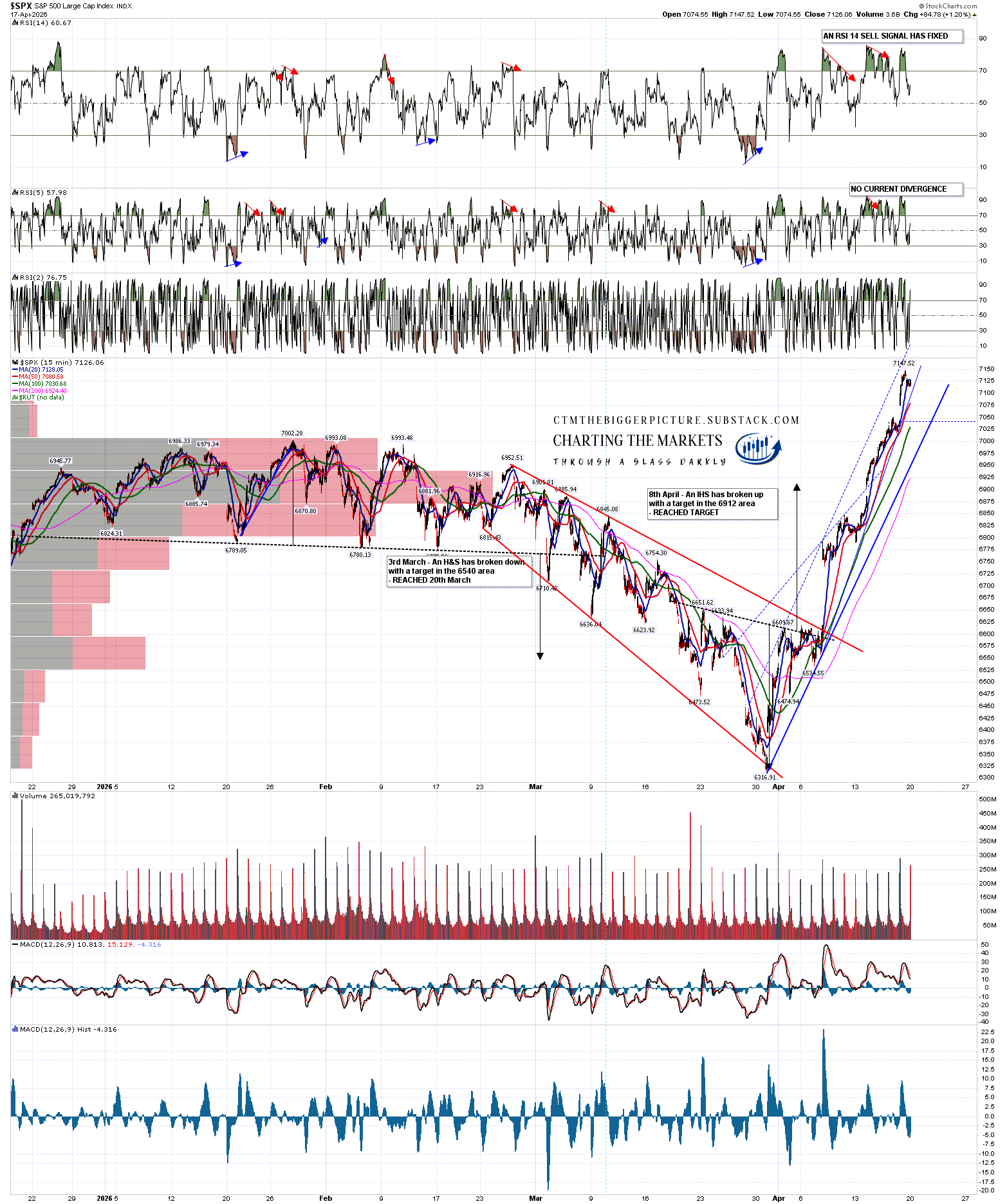
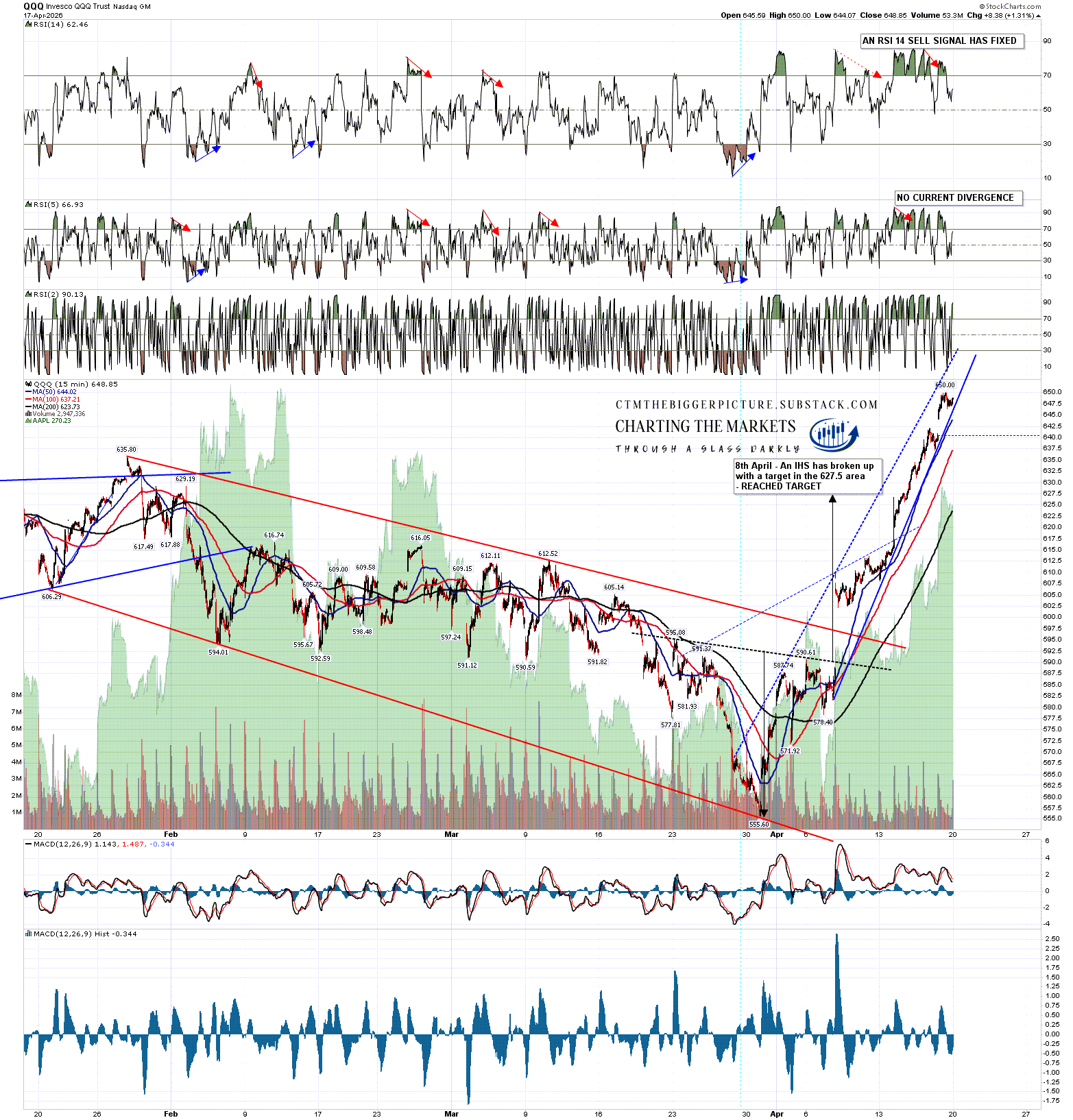
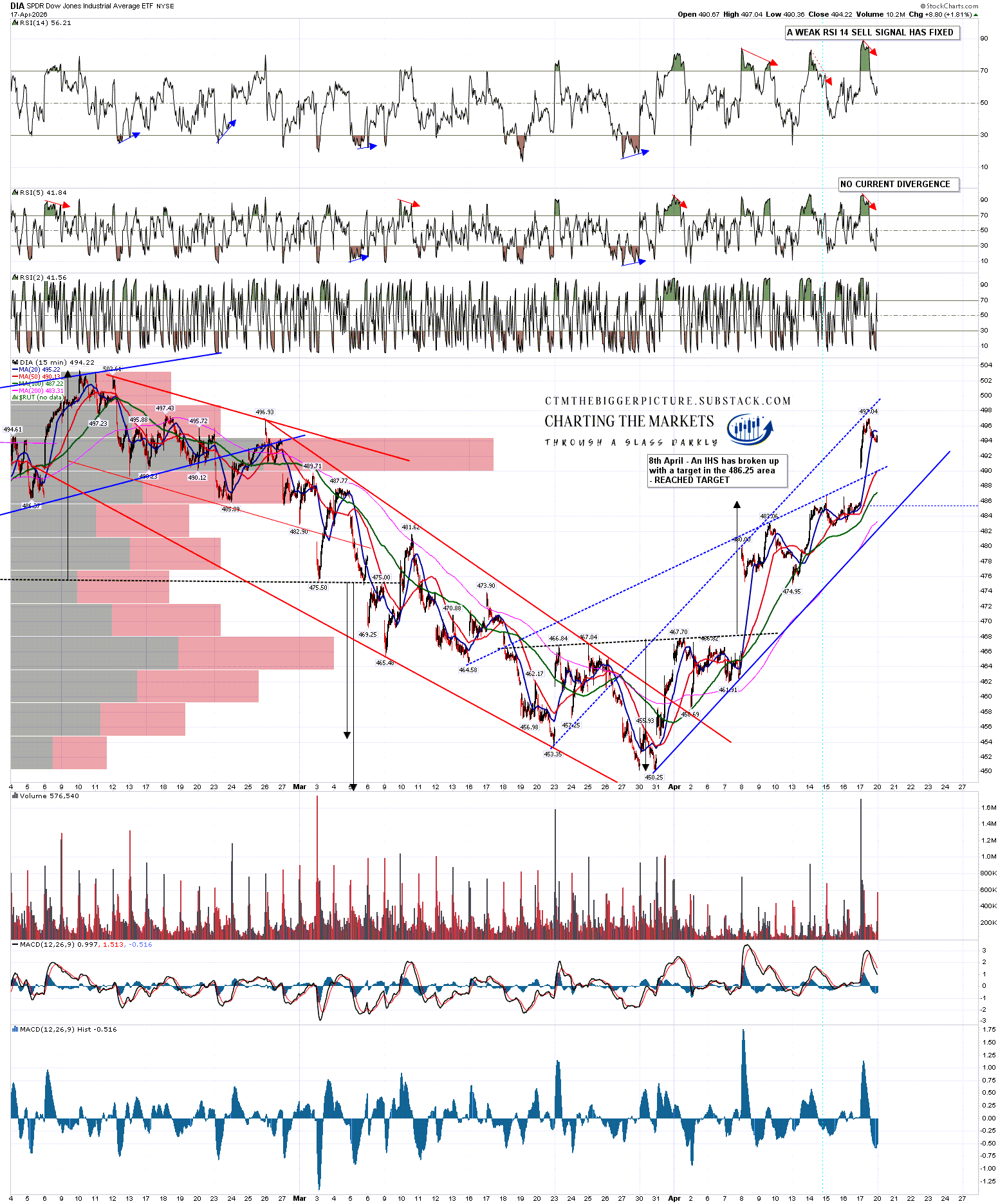
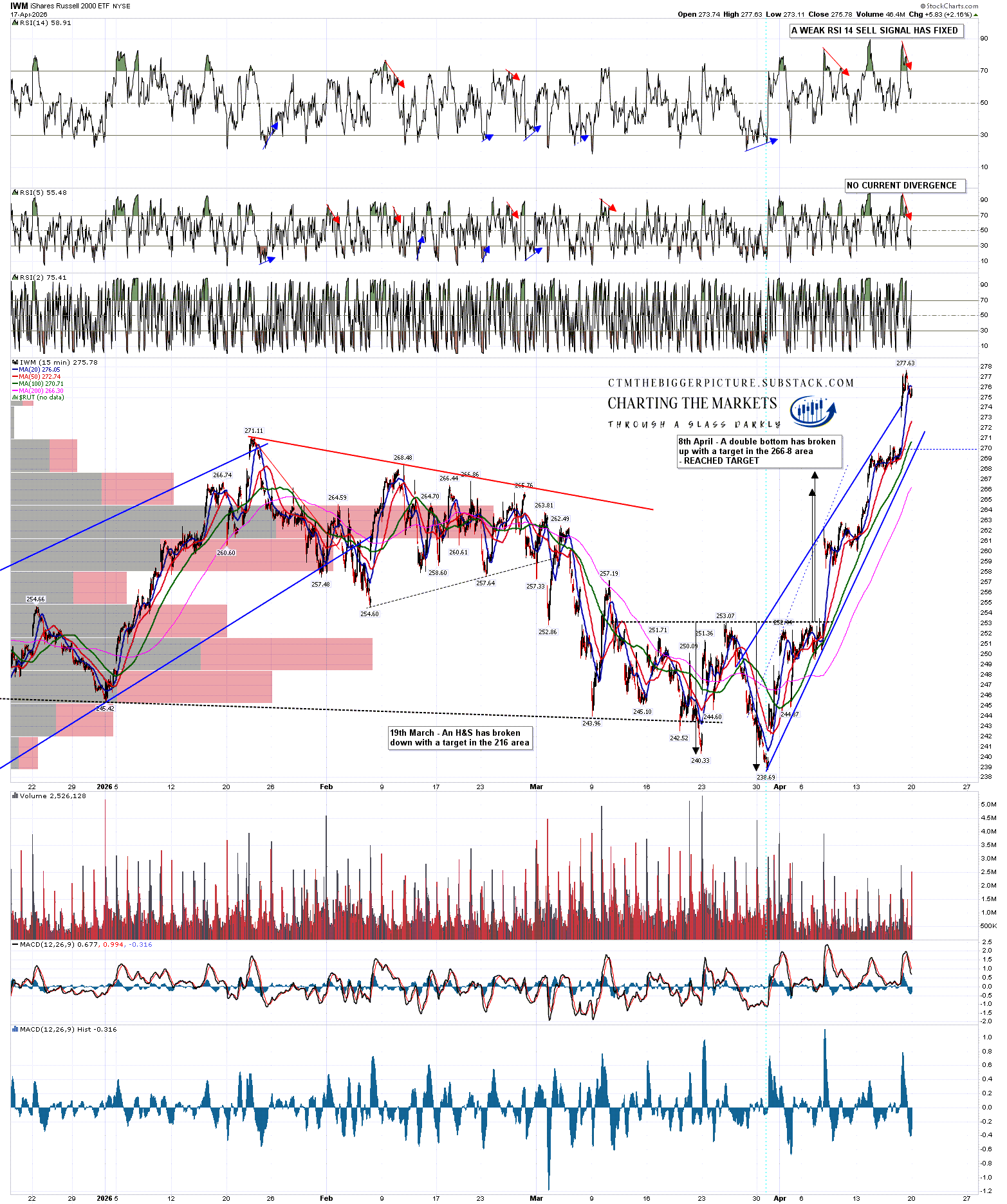
In my post on Wednesday 8th April after Trump declared a ceasefire and accepted talks on the basis of Iran’s ten point plan I posted charts showing bottoming patterns on SPX, QQQ, DIA and IWM that had broken up and those all made their targets last week, with new all time highs on SPX, QQQ and IWM on the back of a ceasefire in Lebanon and numerous statements last week suggesting that a peace deal was close.

That ten point plan from Iran hasn’t changed and is as follows:

  1. A guarantee that Iran will not be attacked again.

  2. A permanent end to the war, not just a ceasefire.

  3. An end to Israeli strikes in Lebanon and against Iranian allies.

  4. Lifting of all US sanctions in Iran.

  5. Reopening of the Strait of Hormuz with a transit fee of $2 million per ship.

  6. Continuation of Iran’s control over the Strait of Hormuz.

  7. Acceptance of Iran’s right to enrich uranium for its nuclear program.

  8. Compensation for war damages to Iran.

  9. Withdrawal of US combat forces from the region.

  10. End to all UN and IAEA resolutions targeting Iran.

As I had mentioned then, these conditions for Iran were a lot for the US to swallow, but it appeared on Friday that the US was likely to accept most of these, squeeze out a couple of concessions from Iran, probably on nuclear enrichment and reparations, and declare a victory that to the rest of the world would look like a major defeat for the US, but would avoid the major global crisis that might well follow an escalation of this war.

On Friday the Strait was reopened on Iran’s conditions and some tankers started flowing through the Strait again, paying a toll to Iran for each transit out of the Strait. Trump said that the US blockade of traffic from Iran would continue until the agreement was finalised.

On Saturday Iran closed the Strait again because the US blockade had not yet been lifted and yesterday the US appears to have attacked and taken over a tanker containing goods destined for China. A further ten thousand US troops have been sent to the Middle East. A US team led by Jared Kushner and Steve Witkoff, two people Iran had insisted that they are not prepared to negotiate with, has been sent to Pakistan for talks with Iran today and tomorrow.

This raises some questions:

  1. Are Iran prepared to negotiate with Kushner and Witkoff?

  2. Were there any actual discussions or agreements last week between the two sides?

  3. Are the US prepared to make any real concessions to Iran?

  4. Are Iran prepared to make any real concessions to the US?

  5. Is the US prepared to escalate this war and risk a global disaster?

Overall this is a dense fog of confusion but two things are obvious. Firstly some traders with amazing prescience are placing trades just before big announcements from Trump, with a short position on oil futures placed twenty minutes before Trump’s peace announcement on Friday morning delivering a profit of over $700 million by the close on Friday.

Secondly if the Iran War escalates from here the all time high retests on SPX, QQQ and IWM last week may all have made the second highs on a series of large double tops. If and when it becomes clear that there is no deal and the war is escalating the reaction from oil and equity markets is likely to be brutal.

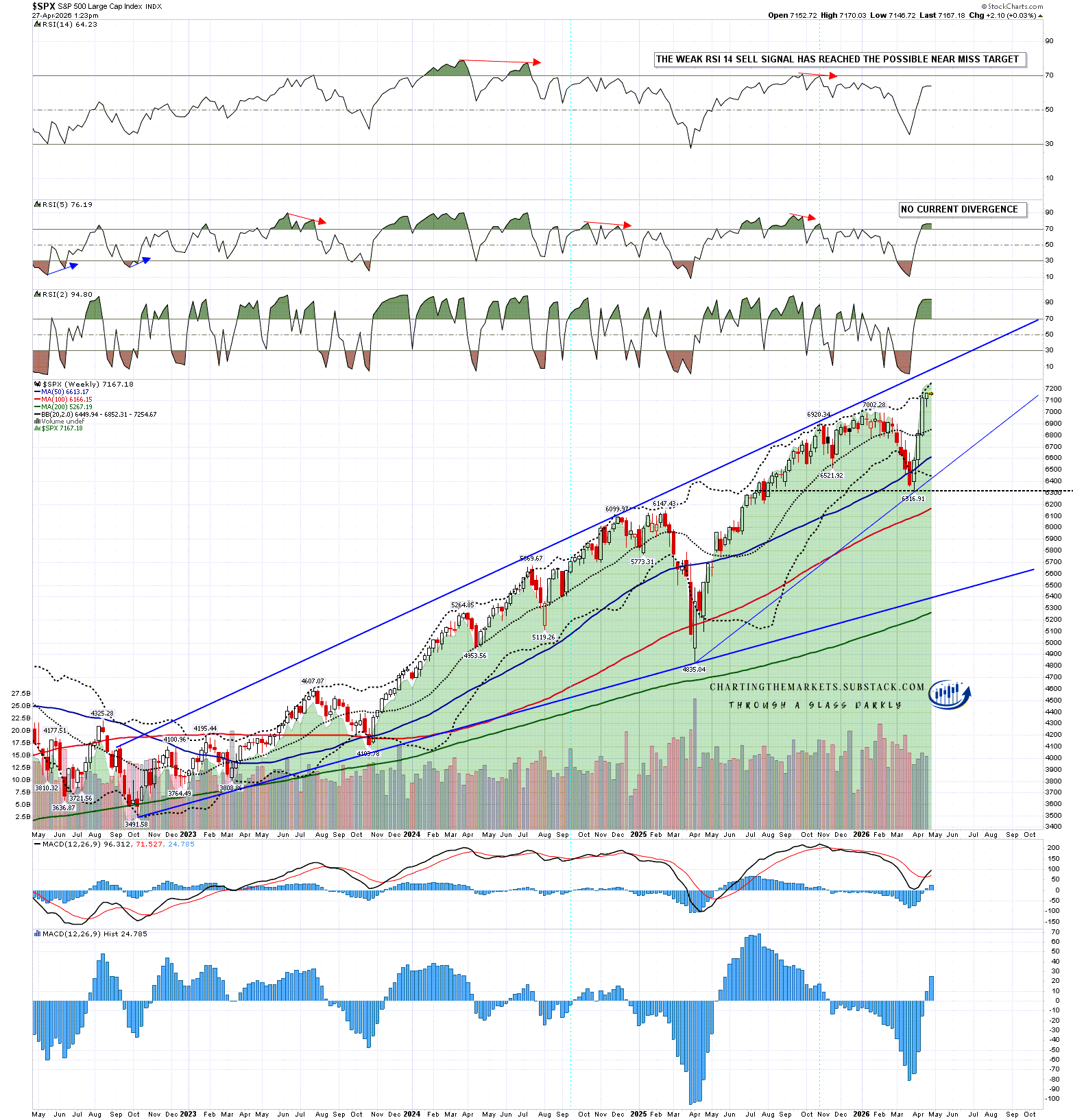
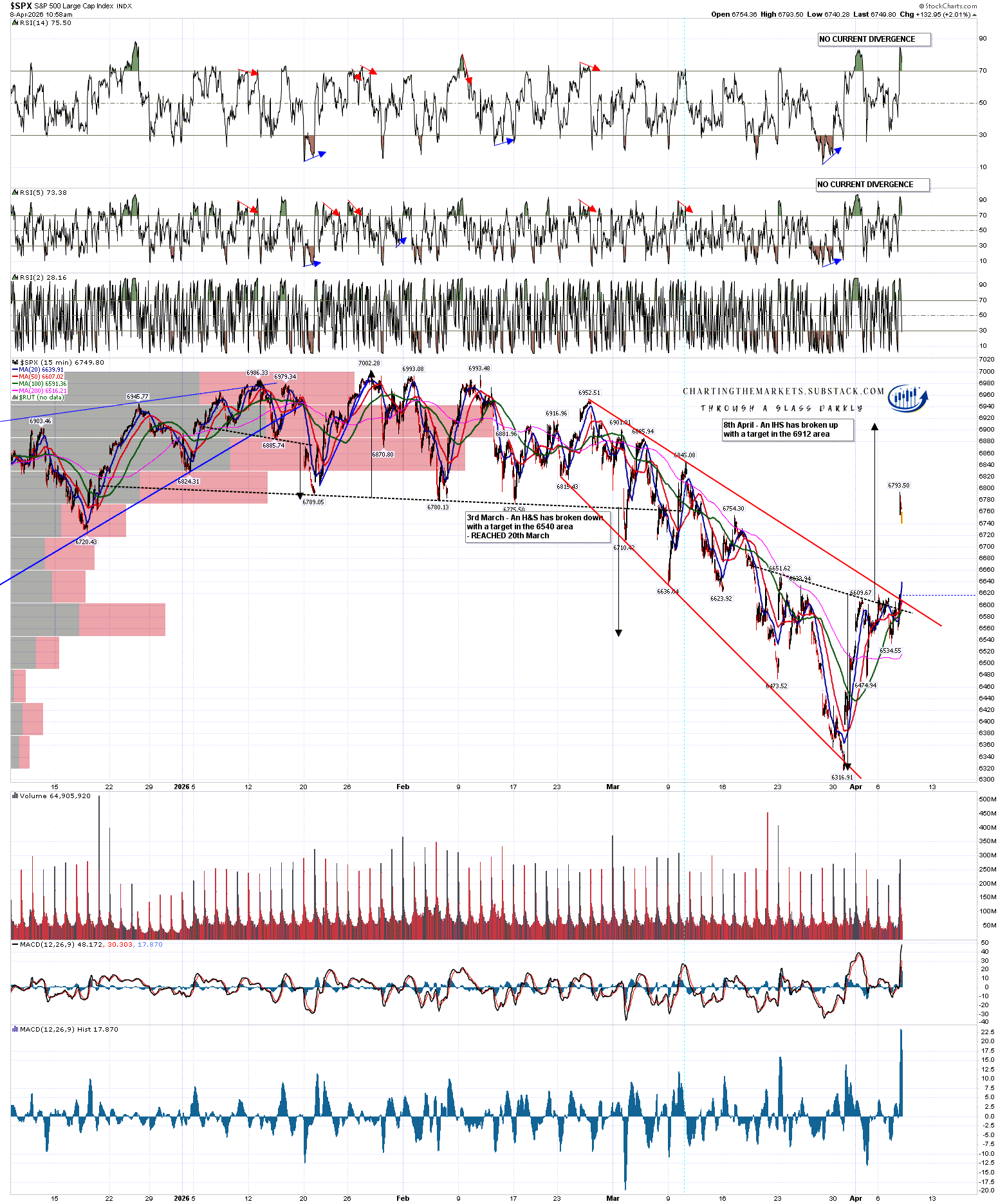
In the meantime SPX made the IHS target at 6912 last week and if this is now a much larger double top the target on a sustained break below the late March low at 6316.91 would currently be in the 5485 - 5530 area:

SPX 15min chart:

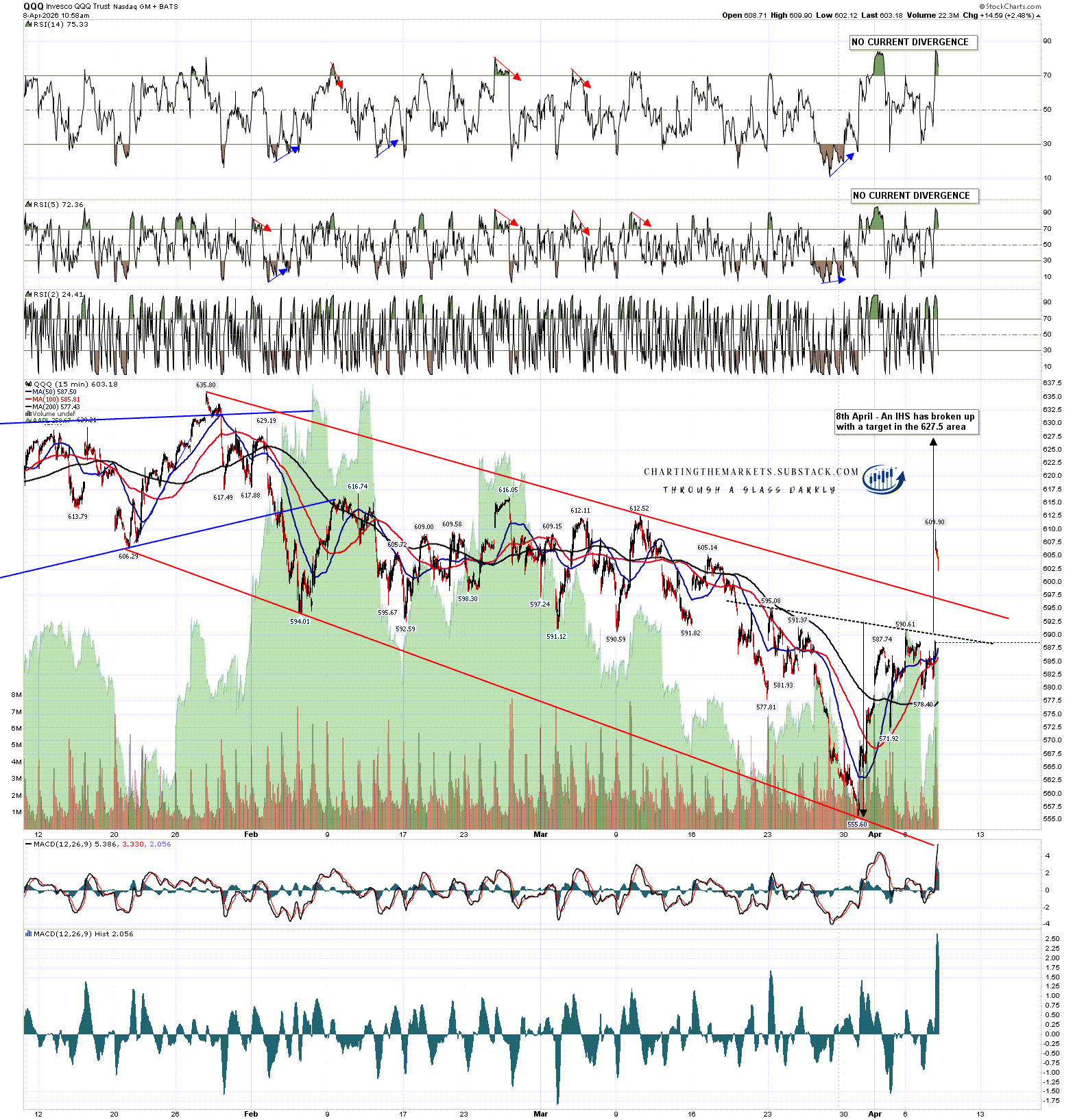
QQQ made the IHS target at 627.5 last week and if this is now a much larger double top the target on a sustained break below the late March low at 555.60 would currently be in the 461 - 477 area:

QQQ 15min chart:

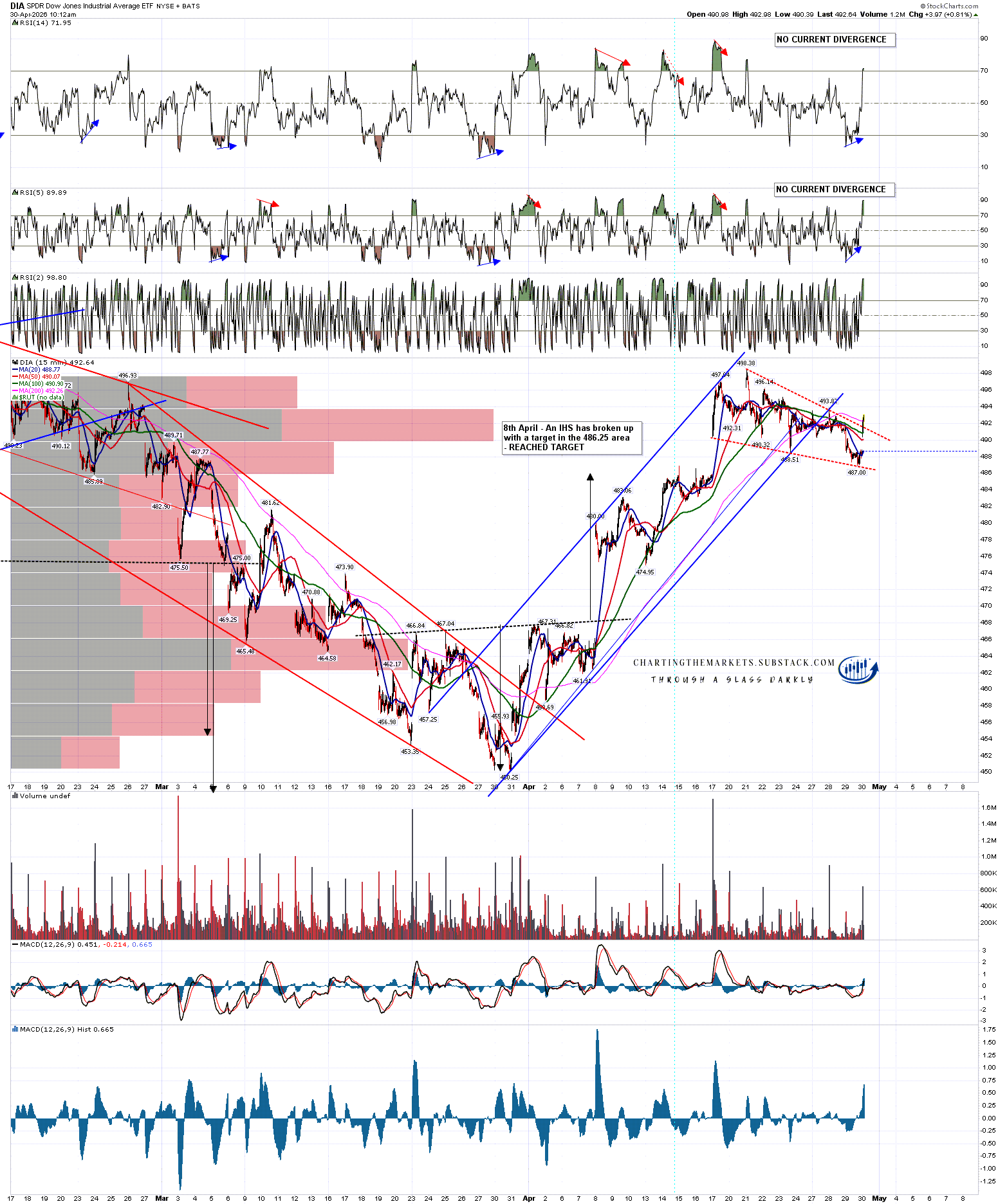
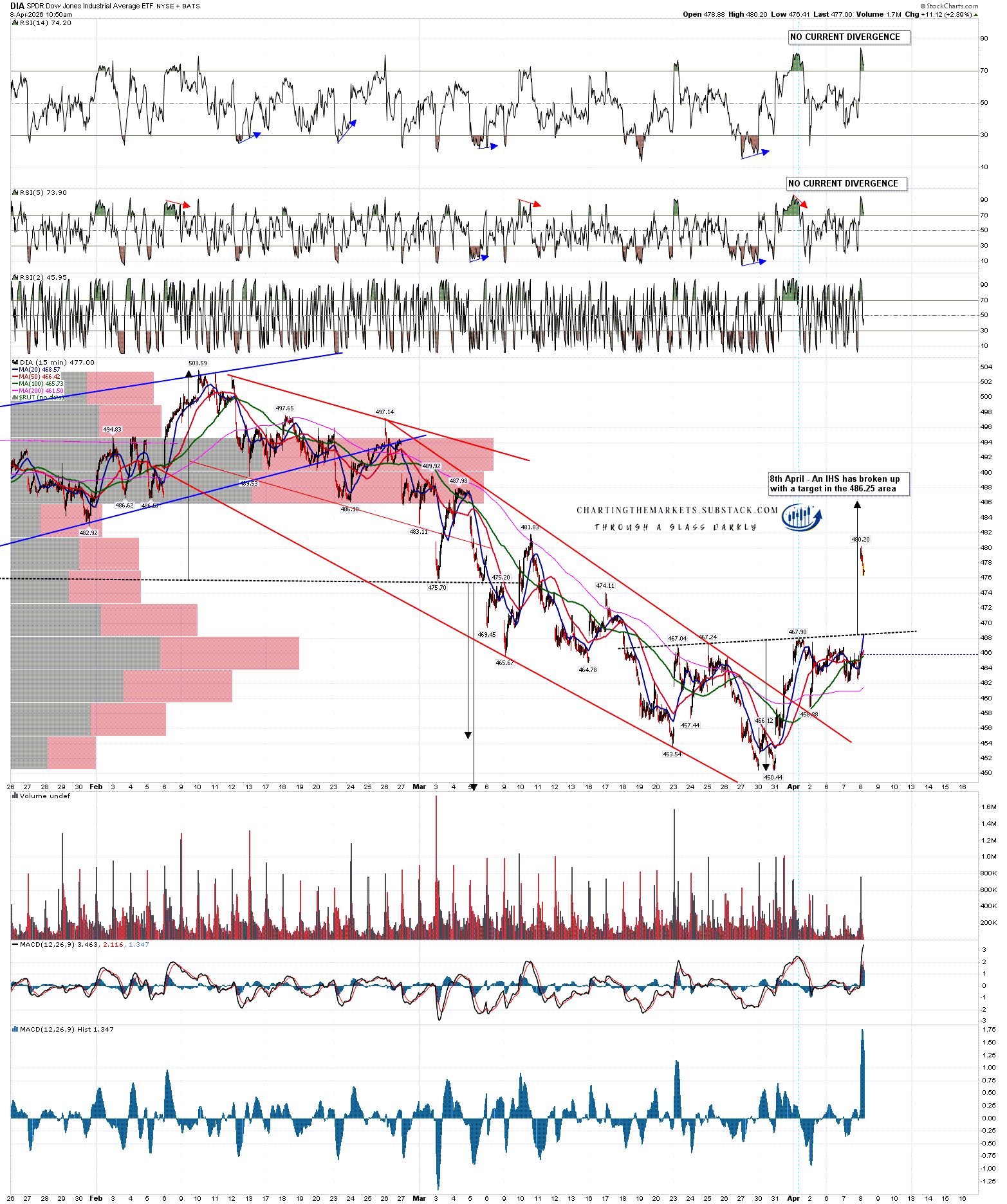
DIA made the IHS target at 486.25 last week and this is not yet a possible double top setup. This could potentially still be the right shoulder of a large H&S forming and a hard break down from here would be looking for a target in the 395 area:

DIA 15min chart:

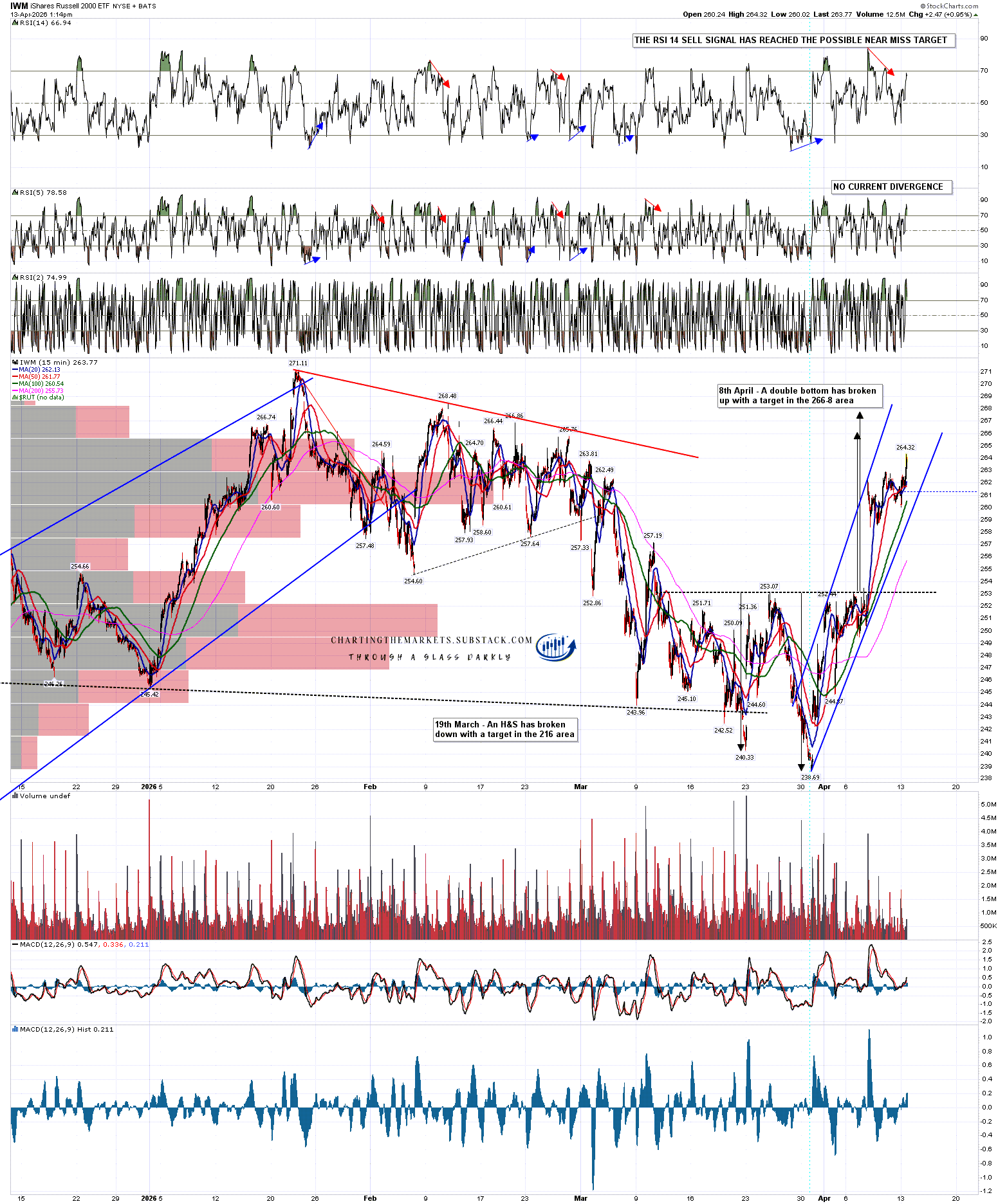
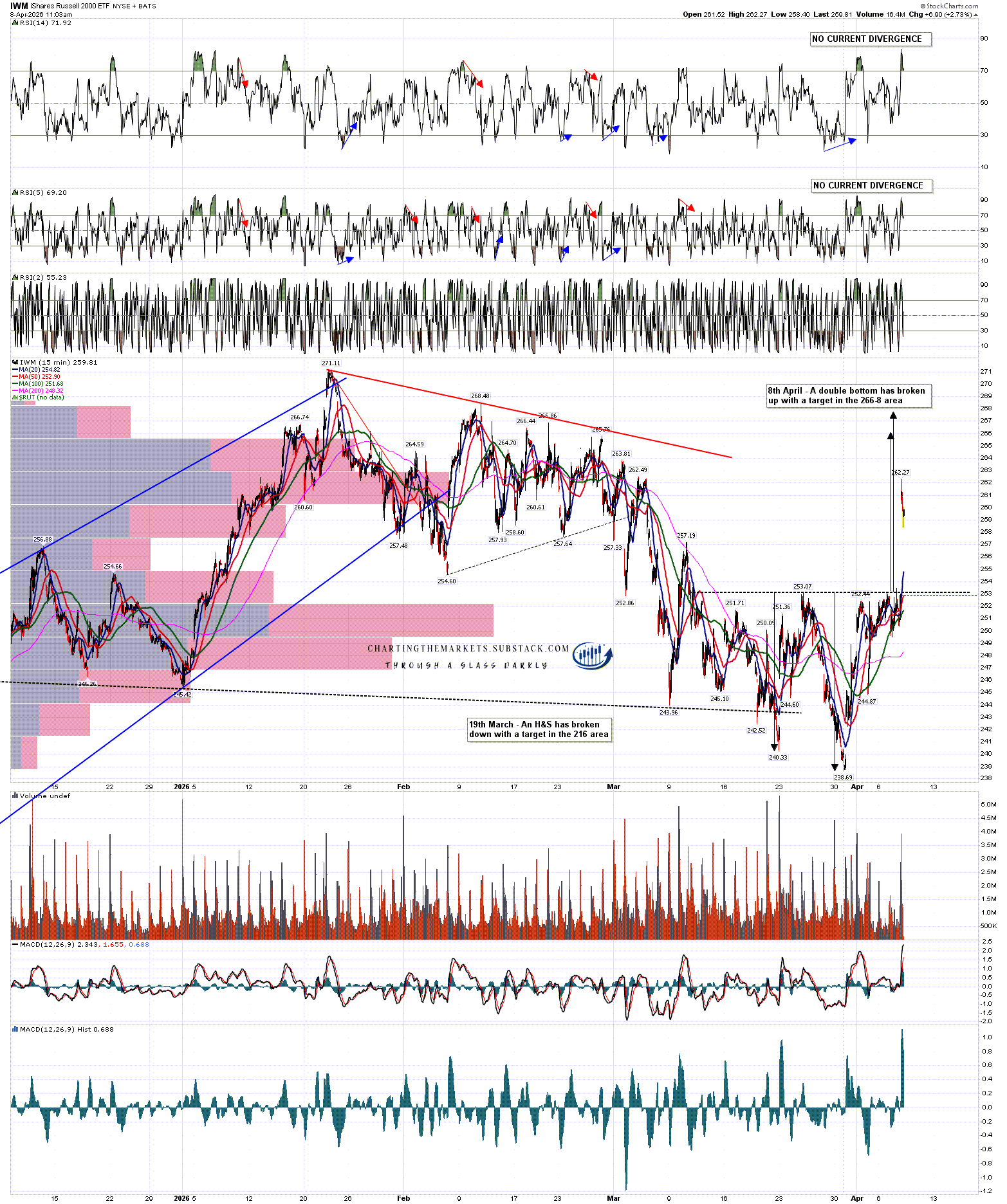
IWM made the double bottom target in the 266-8 area last week and if this is now a much larger double top the target on a sustained break below the late March low at 238.69 would currently be in the 203 - 210 area:

IWM 15min chart:

Sometime before the end of April this fog of confusion over the status of the Iran War should clear enough to see what may happen in May. If the war ends then this crisis is over, though the IEA is telling us it will likely take two years to entirely recover from the disruption caused so far. If the war escalates then equities may well go a lot lower than the lows at the end of March.

I am hopeful but doubtful about seeing a negotiated end to this war yet. We’ll see.

If you like my analysis and would like to see more, please take a free subscription at my chartingthemarkets substack, where I publish these posts first. I also do a premarket video every day on equity indices, bonds, currencies, energies, precious commodities and other commodities at 8.45am EST, but only for paying subscribers. Other places to find me are my page on the platform previously known as twitter, and my YouTube channel.

Monday, 13 April 2026

In The Eye Of The Storm

In my last post on Wednesday last week I was looking at how far the current rally on equities might get, and at the prospects that peace negotiations with Iran might deliver something positive.

I was skeptical about the prospects for a negotiated peace, and the talks in Islamabad on Saturday were abandoned after a day, as there was never really anything to talk about. The ten points that the US had accepted as a basis for negotiation were maximalist demands from Iran that would in effect have been a humiliating surrender by the US, and the alternative proposals from the US team on Saturday were maximalist demands that asked in effect for a humiliating surrender by Iran. The talks never had any realistic chance of success or even progress on this basis.

The key issue for the world economy of course remains the closure of the Strait of Hormuz, and in that respect the situation has now deteriorated. Before the ceasefire only a small number of ships approved by Iran were going through the Strait, and now the US has announced that it will entirely blockade all Iranian ports until Iran allows free passage for all through the Strait of Hormuz. The net effect is that all commercial transit through the Strait of Hormuz has now been stopped by both Iran and the US until further notice.

This raises some questions of course, about whether the US would really attack or confiscate vessels from China, India, Pakistan that were leaving Iranian ports. To do so would of course legally be an act of war against those countries.

In the event that hostilities escalate further then the next obvious move for Iran would be to use their Houthi allies to close the Bab al-Mandab Strait out of the Red Sea:

The Bab al-Mandab Strait isn’t as heavily used as the Strait of Hormuz, mainly because the Houthis have been intermittently firing at shipping there for years, but it has been clear so far in this conflict and the Saudis have been using it as a partial replacement for Hormuz since this war started. If this is closed then millions of barrels a day of oil from Saudi that have managed to keep flowing so far during this war will stop flowing.

You may be wondering whether Saudi could instead send their oil through the Suez Canal and smaller tankers could go that way, but the maximum (Suezmax) size of oil tanker that can go through the Strait is between 120,000 and 180,000 deadweight tonnage (DWT). Most crude oil is carried by Very Large Crude Carriers (VLCC) or Ultra Large Crude Carriers (ULCC), which range from 200,000 to 550,000 DWT, and so are too large to use the Suez Canal.

We already have a major supply shock from this war and there’s not much reason at the moment to think that the war isn’t about to escalate seriously and make that supply shock a lot worse. If that happens the outlook for oil and equity prices will be bleak.

On to the markets where I will review the progress of the bottoming patterns that I was looking at last week on the 15min charts, and the negative divergence that was building over the last two days of last week on the hourly charts.

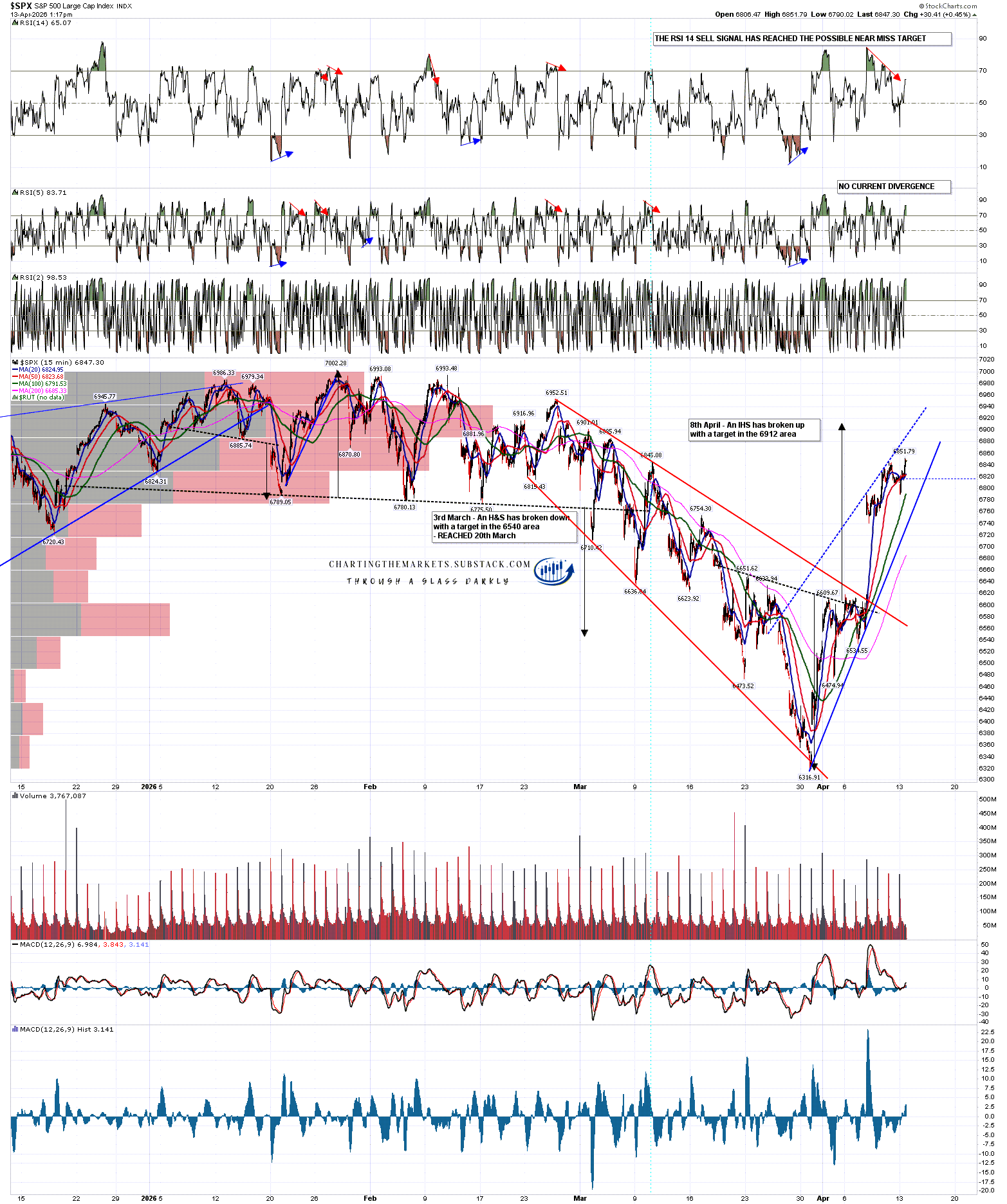
On SPX an IHS had broken up with a target in the 6912 area, and hasn’t progressed much to the upside since I was looking at this on Wednesday. A decent quality rising wedge has formed from the low suggesting a short term high may be close.

SPX 15min chart:

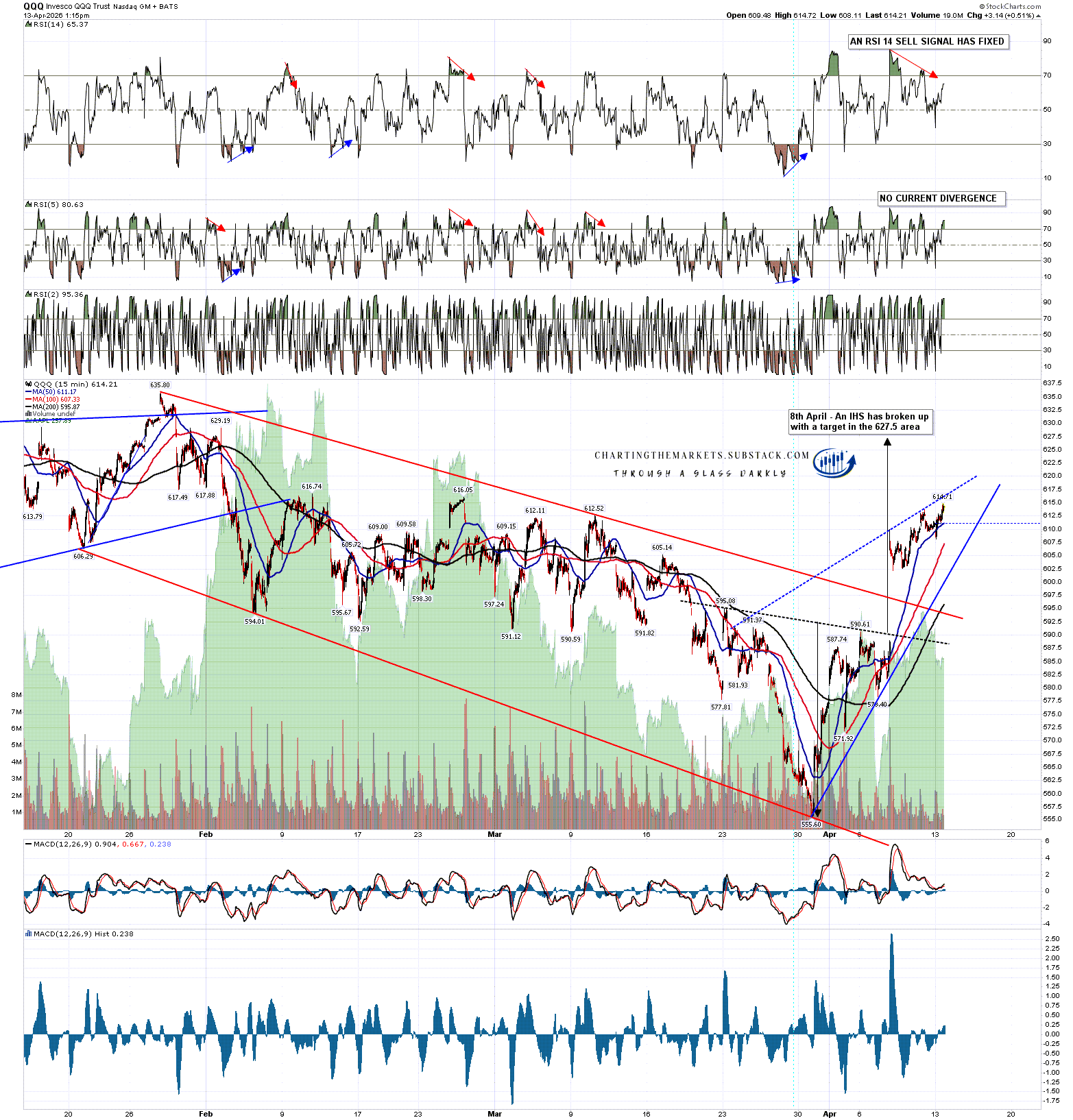
On QQQ an IHS had broken up with a target in the 627.5 area, and hasn’t progressed much to the upside since I was looking at this on Wednesday. A decent quality rising wedge has formed from the low suggesting a short term high may be close.

QQQ 15min chart:

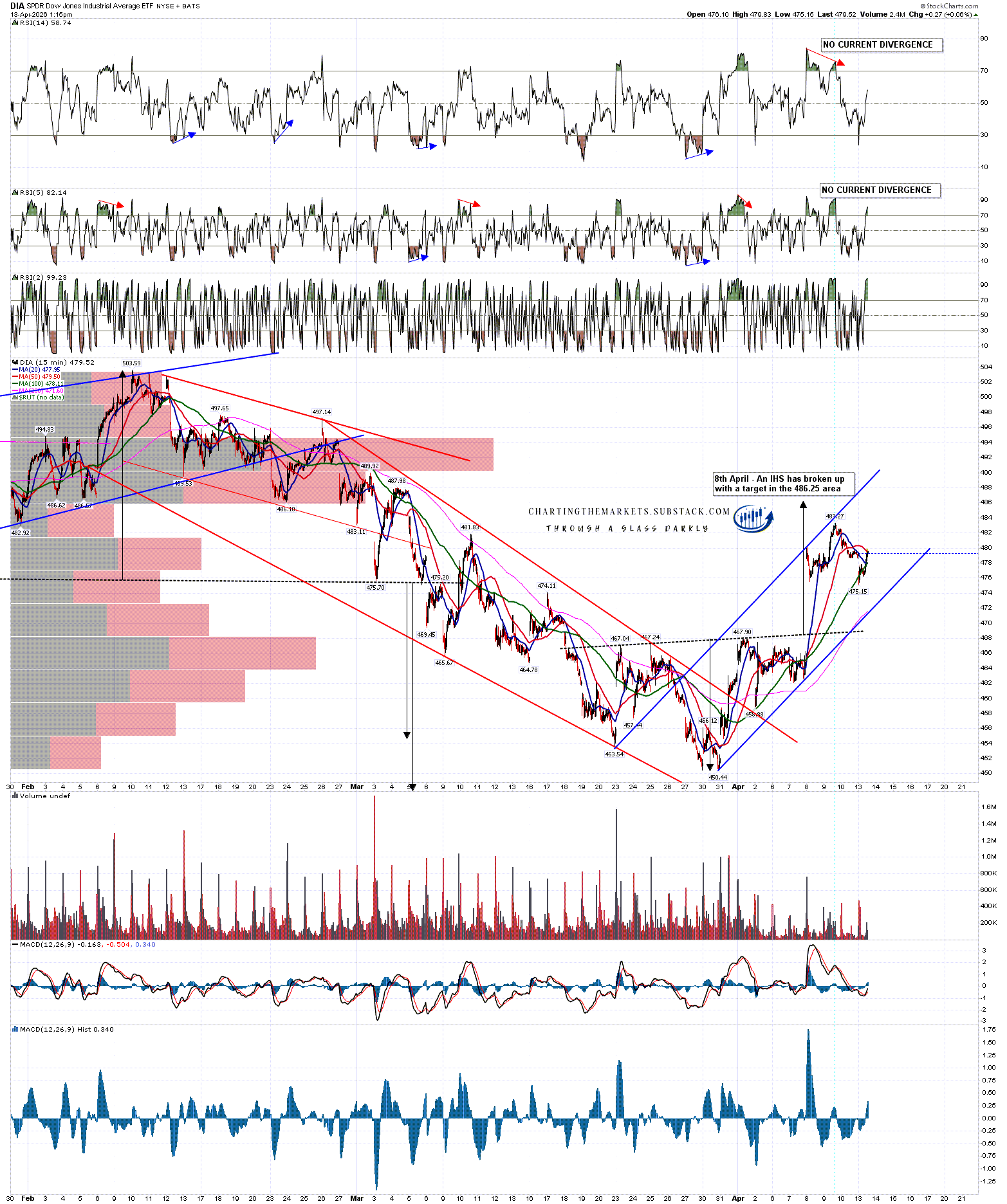
On DIA an IHS had broken up with a target in the 486.25 area, and hasn’t progressed much to the upside since I was looking at this on Wednesday. A high quality rising channel has formed from the low suggesting a short term high may be close.

DIA 15min chart:

On IWM a double bottom had broken up with a target in the 266-8 area, and hasn’t progressed much to the upside since I was looking at this on Wednesday. A decent quality rising megaphone has formed from the low suggesting a short term high may be close.

IWM 15min chart:

All of these targets are fairly close and with these indices all currently at or close to rally highs day they may all still be hit.

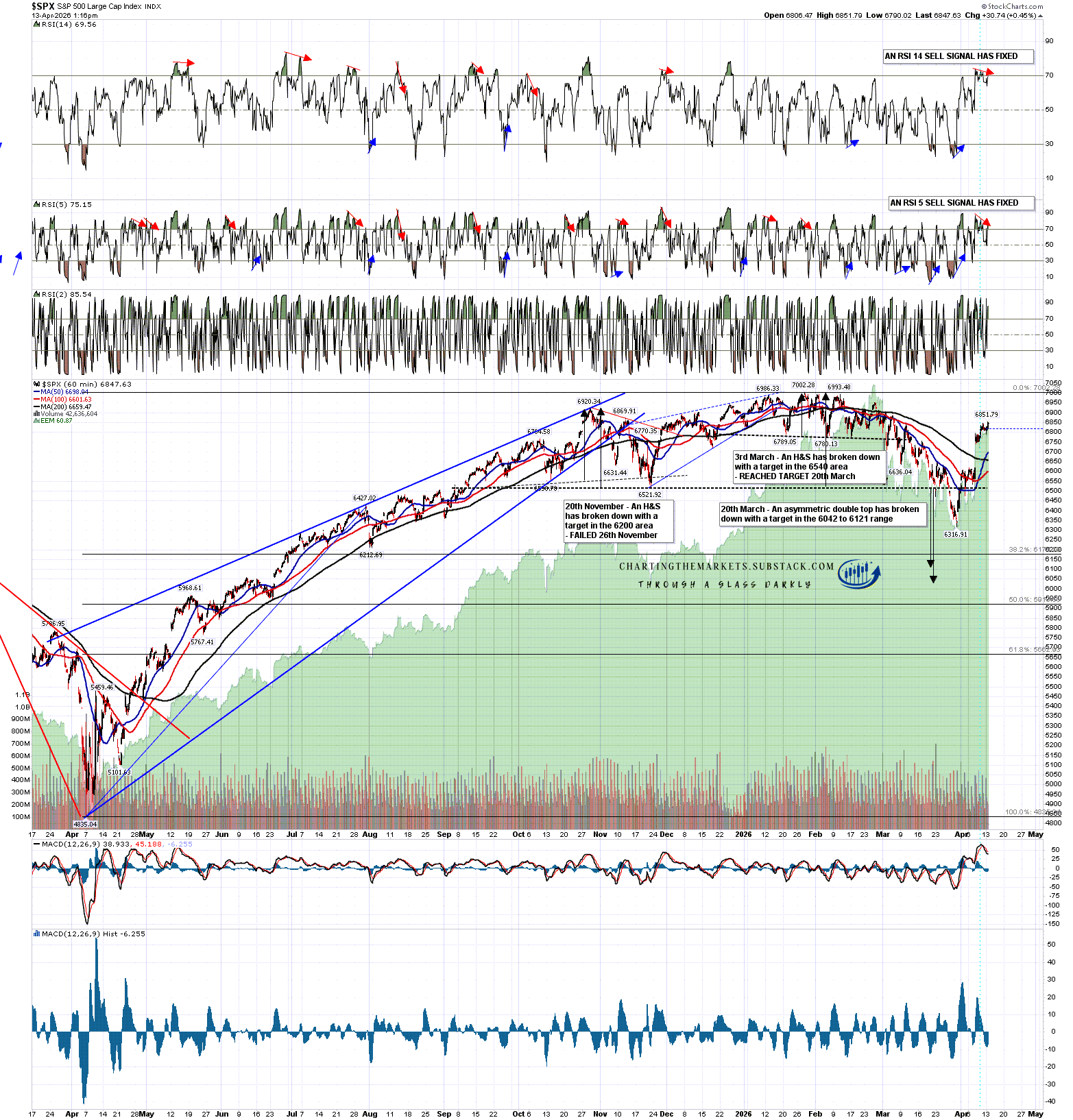
There is a lot of negative divergence on the hourly charts here though, and on the SPX hourly chart below you can see that both RSI 14 and RSI 5 sell signals fixed on Friday.

SPX 60min chart:

I was warning subscribers from Thursday night that hourly sell signals were brewing across the board and other than SPX there are also:

  • QQQ - Hourly RSI 14 sell signal brewing, RSI 5 sell signal fixed.

  • DIA - Hourly RSI 14 sell signal fixed, RSI 5 sell signal reached target.

  • IWM - Hourly RSI 14 and RSI 5 sell signals fixed.

I’m expecting a short term high soon and all these sell signals will likely reach their targets at the 30 area on their respective RSIs. In the absence of any actual good news on the Iran War, and I’m not currently seeing much reason to expect any, we’ll likely be seeing lower lows in the near future.

If you like my analysis and would like to see more, please take a free subscription at my chartingthemarkets substack, where I publish these posts first. I also do a premarket video every day on equity indices, bonds, currencies, energies, precious commodities and other commodities at 8.45am EST, but only for paying subscribers. Other places to find me are my page on the platform previously known as twitter, and my YouTube channel.
Wednesday, 8 April 2026

Apocalypse Postponed

In my last post on Monday I gave 10% odds that a deal with Iran was reached by the time that Trump’s deadline expired yesterday evening, and no deal was reached, but Trump nonetheless said that the Iran’s existing ten point point proposal to end the war was a sufficient basis to start to negotiate a deal over the next two weeks, during which time there would be a ceasefire. US equity markets have rallied and oil prices have dropped hard on that news.

Iran’s ten point plan is as follows:

  1. A guarantee that Iran will not be attacked again.

  2. A permanent end to the war, not just a ceasefire.

  3. An end to Israeli strikes in Lebanon and against Iranian allies.

  4. Lifting of all US sanctions in Iran.

  5. Reopening of the Strait of Hormuz with a transit fee of $2 million per ship.

  6. Continuation of Iran’s control over the Strait of Hormuz.

  7. Acceptance of Iran’s right to enrich uranium for its nuclear program.

  8. Compensation for war damages to Iran.

  9. Withdrawal of US combat forces from the region.

  10. End to all UN and IAEA resolutions targeting Iran.

Obviously this is the same ten point plan that Iran presented days into the war as a precondition for talks and had previously been dismissed as an unrealistic demand for a humiliating surrender by the US, but it seems likely that the US will be trying to negotiate a variant on these ten points that would allow Trump to save some face.

In the short term there are a few issues:

  1. The US has not explicitly accepted these ten points in full, so Iran will need to be flexible about negotiating without these having first all been agreed.

  2. Israel has refused a ceasefire in Lebanon, and Iran may not accept the rest of the ceasefire without this.

  3. US Gulf allies are very unhappy with a new status quo that would likely leave Iran much more powerful in the region after this war.

  4. It is unclear to what extent the Strait of Hormuz will be open during these negotiations. Before the war 100 to 200 vessels per day passed through the Strait and so far Iran only seems to have agreed to allow ten to fifteen vessels through the Strait, and it currently seems unclear whether that would be per day or in total during the two week negotiation window.

In the meantime Iranian crowds are celebrating complete victory over the US, while Trump has declared complete victory over Iran.

Will these negotiations be brought to a successful conclusion? Hard to say but given that Trump’s rhetoric yesterday seemed to be suggesting that Iran might be destroyed with nuclear weapons over the rest of this week, pretty much anything else seems like good news.

Do we likely have a pause in the Iran War that could last at least until the end of this week? Yes, and that brings us back to the US equity markets, where a series of bottoming patterns broke up yesterday afternoon and overnight.

On SPX an IHS has broken up with a target in the 6912 area:

SPX 15min chart:

On QQQ an IHS has broken up with a target in the 627.50 area:

QQQ 15min chart:

On DIA an IHS has broken up with a target in the 486.25 area:

On IWM a double bottom has broken up with a target in the 266-8 area:

IWM 15min chart:

At minimum it seems likely that we should see at least a few days pause in this war, and even if the warring parties can’t reach agreement then the pause itself gives some time for things to develop in a positive way.

There’s an old story about a man who delayed a death sentence by promising to teach a king’s horse to sing within one year. As he persevered in this task day after day he was asked by a passer-by why he he had agreed to do this. He replied that a lot of things could happen in a year, the king could die, the horse could die, he himself could die, and who knew, perhaps the horse might even learn to sing.

In the meantime all these pattern targets on the four indices above look doable, and I am wondering about possible all time high retests. If negotiations then fail any high retests might then set up much larger topping patterns for the next leg down.

If you like my analysis and would like to see more, please take a free subscription at my chartingthemarkets substack, where I publish these posts first. I also do a premarket video every day on equity indices, bonds, currencies, energies, precious commodities and other commodities at 8.45am EST, but only for paying subscribers. Other places to find me are my page on the platform previously known as twitter, and my YouTube channel.
Monday, 6 April 2026

'Tis But A Scratch

I read a few days ago that John Cleese was saying that politics in the US nowadays seems like an endless Monty Python sketch, and he has a point. Before I look at the US equity markets today I just want to reflect on the bizarre nature of the news we are watching nowadays.

In the ‘special military operation’ in Iran it is now clear that there were never any negotiations with Iran since the war started, and it isn’t even clear that the US wanted any talks, as the person preparing to negotiate on the Iranian side, former Iranian foreign minister Kamal Kharazi, was seriously wounded in a US/Israeli attack on his Tehran home three days ago. If he survives, his enthusiasm for future negotiations might be somewhat dampened by his wife’s death in that failed assassination attempt.

Trump declared on Saturday on Truth Social that there were only 48 hours left of the ten day pause he gave to the Iranians, and if there is no ‘deal’ in that time, which frankly seems doubtful, then he would rain down hell on the civilians of Iran. Since then he has said in another ‘Truth’ that he will now not start bombing Iran ‘back to the Stone Age’ until Tuesday (tomorrow).

Obviously that would likely be a war crime but perhaps, with the two world leaders Trump seems to respect most, Netanyahu and Putin, not necessarily in that order, both having open warrants out for their arrest for war crimes by the ICC in the Hague, that may nowadays seem more a badge of honor than a brand of shame. Certainly it has not stopped inviting both of them onto his Board (or Bored?) of Peace in a move that seems almost beyond parody.

In the meantime Trump has at various times recently declared that the regime has already been changed in Iran, that he has never been more beloved by US voters, that the USA has never been more respected in the world, that he will be conquering Cuba next, and is asking for an almost doubling of the 2024 defence budget to $1.5trn in 2027, while explaining in a speech last week, that was very briefly publicly posted by the White House, that the federal Government could no longer afford non-military expenses like Medicaid, Medicare or childcare in future as it needs to focus on war.

It is all madness of course, but nowadays also just another weekend in 2026. These are strange days.

On to the markets, where I am giving 10% odds that there is any kind of a deal with Iran before Tuesday, after which the Iran War is currently scheduled to escalate considerably. That being the case the path downwards on SPX, QQQ, DIA and IWM is clear and, unless peace breaks out unexpectedly, all those targets are likely to be reached within weeks.

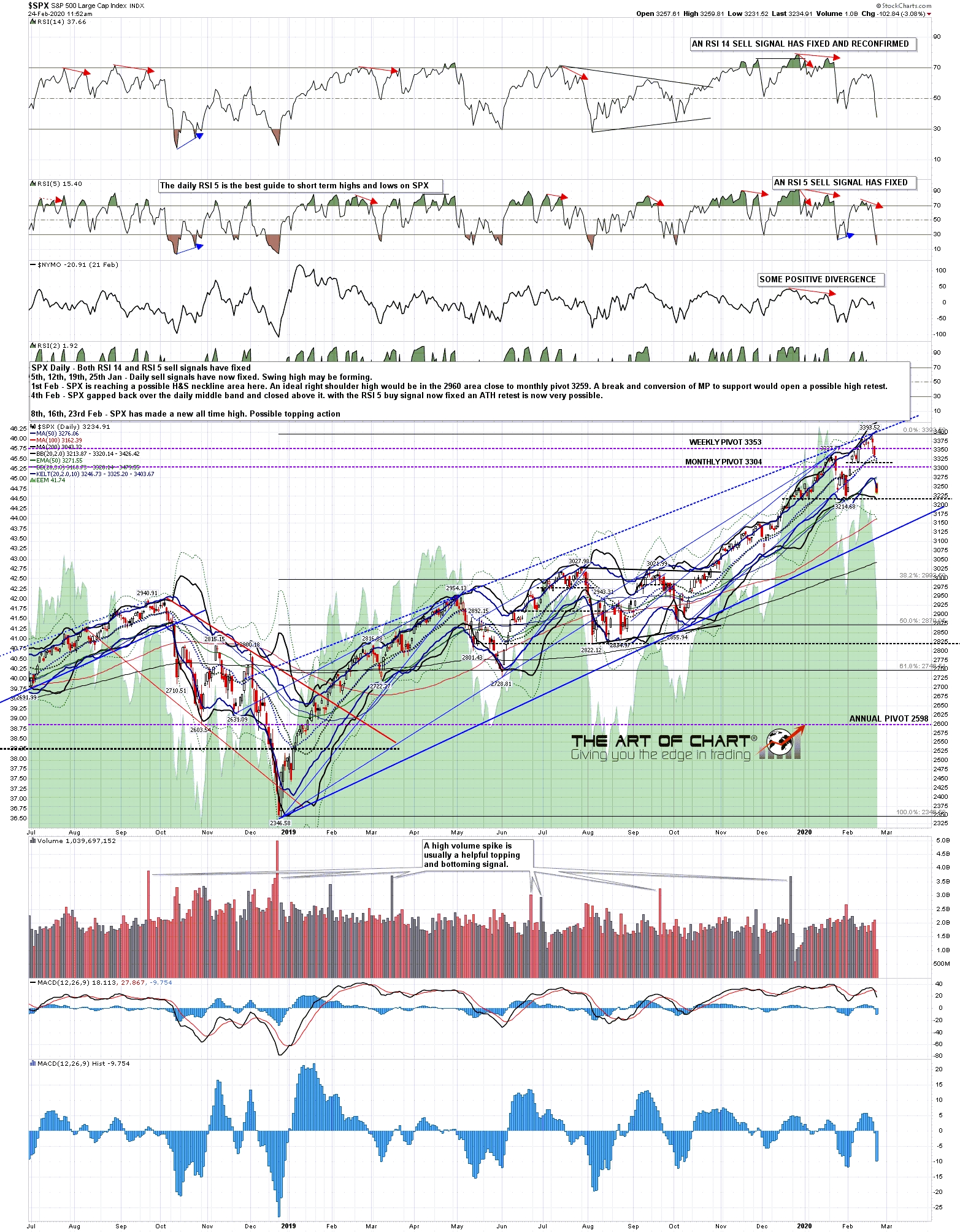
On SPX a decent quality asymmetric double top broke down on Friday 20th March. The double top target is in the 6042 to 6121 range.

The downtrend looks solid with the break down below the 200dma, currently in the 6645 area, broken on Thursday 19th March and backtested as resistance shortly afterwards. More recently the daily middle band, currently in the 6607 area was backtested and held as resistance on Wednesday and Thursday last week. The double top target range is slightly above the 50% retracement of the rising wedge from the April low last year.

SPX daily chart:

On QQQ a double top also broke down on Friday 20th March with a target in the 523-4 range.

The downtrend looks solid with the break down below the 200dma, currently in the 593 area, broken on Friday 20th March and backtested shortly afterwards. More recently the daily middle band, currently in the 589 area was backtested and held as resistance on Wednesday and Thursday last week. The double top target range is slightly above the 50% retracement of the rising wedge from the April low last year.

QQQ daily chart:

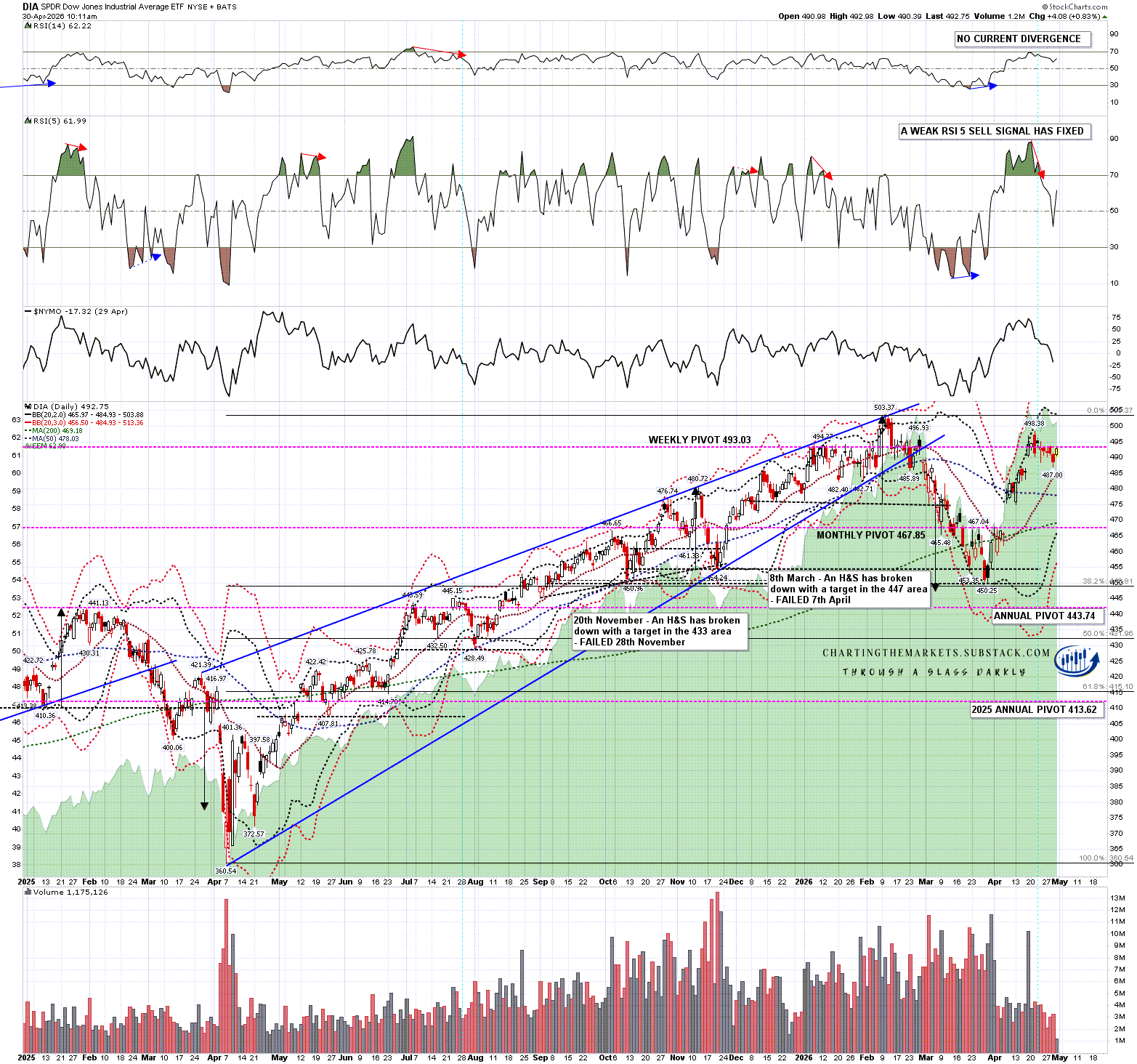
On DIA an H&S broke down on 8th March with a target in the 447 area, and the low on Friday 27th March was 450.49, close to that target.

I was watching in my last post for a possible right shoulder rally from that area that could form a right shoulder on a larger H&S, and we saw that. A sustained break below 450 would therefore look for a target in the 397 area. This is a lower target than on the other indices and would likely take longer to reach.

The daily middle band was aggressively tested as resistance on Wednesday and Thursday last week and have held so far. A daily RSI 5 buy signal fixed at the start of last week but in a strong downtrend these signals are often just run over by the trend.

DIA daily chart:

IWM broke down from an H&S on Thursday 19th March with a target in the 216 area, slightly below the 50% retracement of the rising wedge from the April low last year.

IWM broke above the daily middle band, currently in the 248 area and closed above again on Friday. If, as seems likely, all these equity indices are going to fail into lower targets then I’d be looking for a close back below the daily middle band today or tomorrow.

A daily RSI 5 buy signal fixed at the start of last week but in a strong downtrend these signals are often just run over by the trend. A decent rally over the next few days could see that reach target.

IWM daily chart:

The Iran War seems very likely to intensify in the short term and that is likely to send oil prices up and equity prices down. Much suffering is likely to be caused in Iran by US bombing but is unlikely to matter much strategically. The Iranians don’t have to win this war, all they need to do is survive.

The US won every battle in Iraq but still lost the war. The calculus is similar in Iran but they are much more united, almost three times the size, sitting in terrain that strongly favors the defender, and able to close not only the Strait of Hormuz but likely also the arguably even more important Bab al-Mandab that is currently taking a lot of displaced Strait of Hormuz traffic and is also a vital waterway for the Suez Canal. If both are closed then world trade will be badly affected and we will likely see oil prices break over $200 per barrel.

If you like my analysis and would like to see more, please take a free subscription at my chartingthemarkets substack, where I publish these posts first. I also do a premarket video every day on equity indices, bonds, currencies, energies, precious commodities and other commodities at 8.45am EST, but only for paying subscribers. Other places to find me are my page on the platform previously known as twitter, and my YouTube channel.